Greek mythology is filled with wars, sieges and single
combats that change the course of entire heroic
generations. Explore what happened, who was involved
and where each battle fits into the wider mythology.
What were the major battles in Greek mythology?
Some conflicts decide the fate of cities and dynasties.
Others are personal duels between individual heroes whose
deaths transform a much larger war.
The entries below link directly into the existing
Mythos Kosmos stories and character pages, so each
battle can be followed into the wider mythology around it.
Find a battle or hero
Search the Battles
Search by battle, war, hero, city or participant.
No battles found
Try another battle, hero or place name.
Battle Cycle
Divine Wars
Conflicts that establish or threaten the cosmic order ruled by Zeus and the Olympians.
Cosmic War
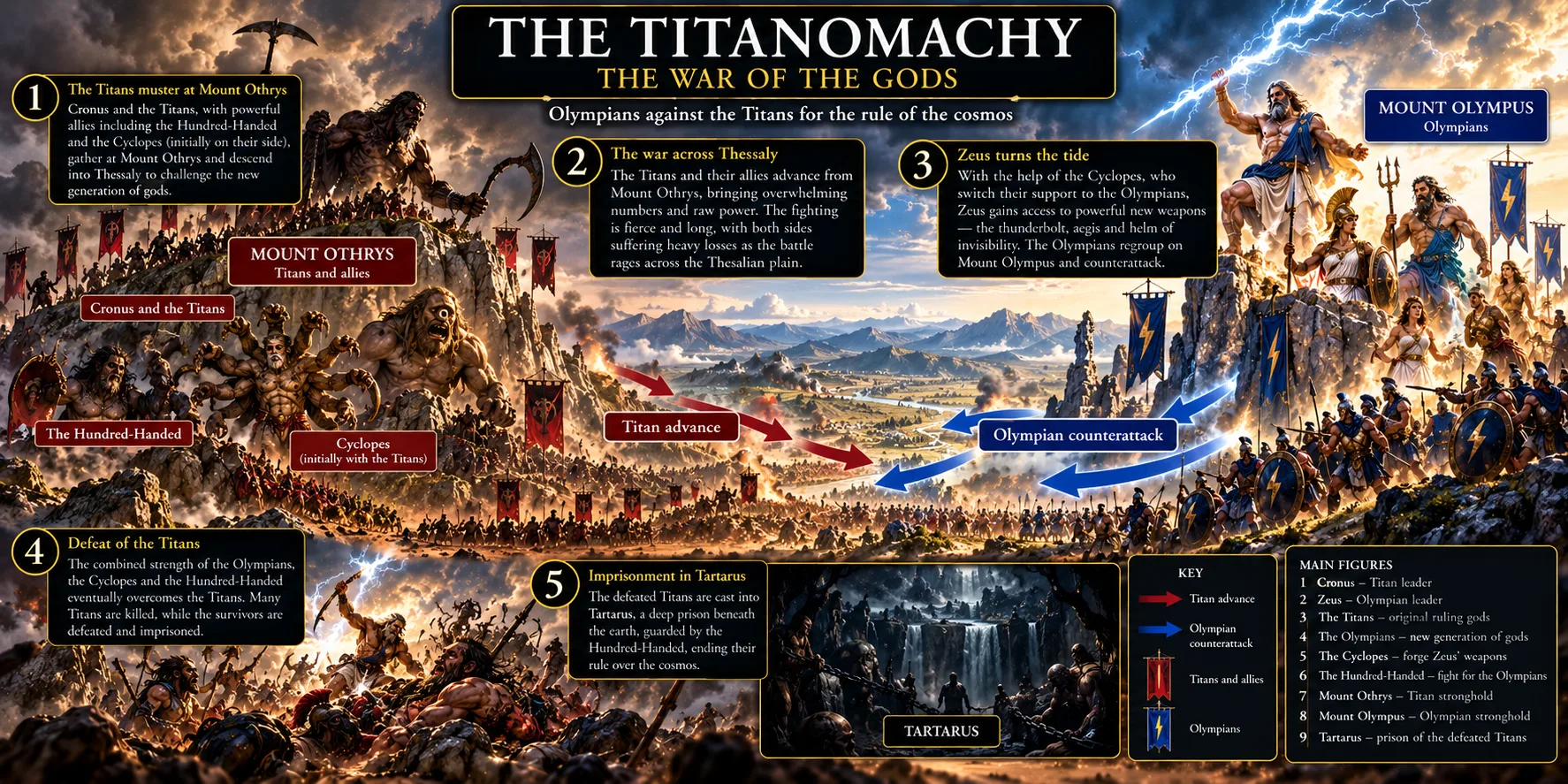
The Titanomachy
Zeus and the younger gods wage a vast war against Cronus and the Titans. Their victory ends Titan rule and establishes the Olympian generation.
Location
Cosmic conflict traditionally associated with Olympus and the Titans; no precise battlefield geography is preserved.
Sides
Zeus and the younger gods, supported by the Cyclopes and Hecatoncheires, against Cronus and the Titans.
Forces
No meaningful troop numbers are preserved. The sources describe divine generations and supernatural allies rather than mortal armies.
Objective
Zeus and his siblings seek to overthrow the rule of Cronus and end the supremacy of the Titans.
Source-based schematic
Battle Movement
Not to geographic scale
This diagram shows movements or positions described
in the surviving literary tradition. It does not
claim to reconstruct exact ancient battlefield
coordinates.
Illustrated interpretation of the Titanomachy and the overthrow of the Titans.
The opposing strongholds, movements and battlefield geography are schematic,
reflecting a cosmic conflict rather than a geographically reconstructable battle.
Battle Analysis
Strategy
The war is not won simply by continuing the same contest. Zeus changes the balance by releasing powerful beings imprisoned in Tartarus and bringing them into the conflict as allies.
Tactics
The surviving accounts emphasise overwhelming supernatural force: Zeus employs thunder and the thunderbolt, while the Hecatoncheires attack the Titans with enormous volleys of stones.
Turning Point
The decisive strategic shift comes when Zeus gains the Cyclopes and Hecatoncheires as allies.
Decisive Move
The combined assault of Zeus and the newly freed allies overwhelms the Titan resistance.
Why did the result happen?
Zeus succeeds by expanding his coalition and gaining weapons and allies capable of breaking a war that had otherwise remained unresolved.
Outcome
Cronus and the defeated Titans lose power. The hostile Titans are confined in Tartarus and the Olympian generation becomes dominant.
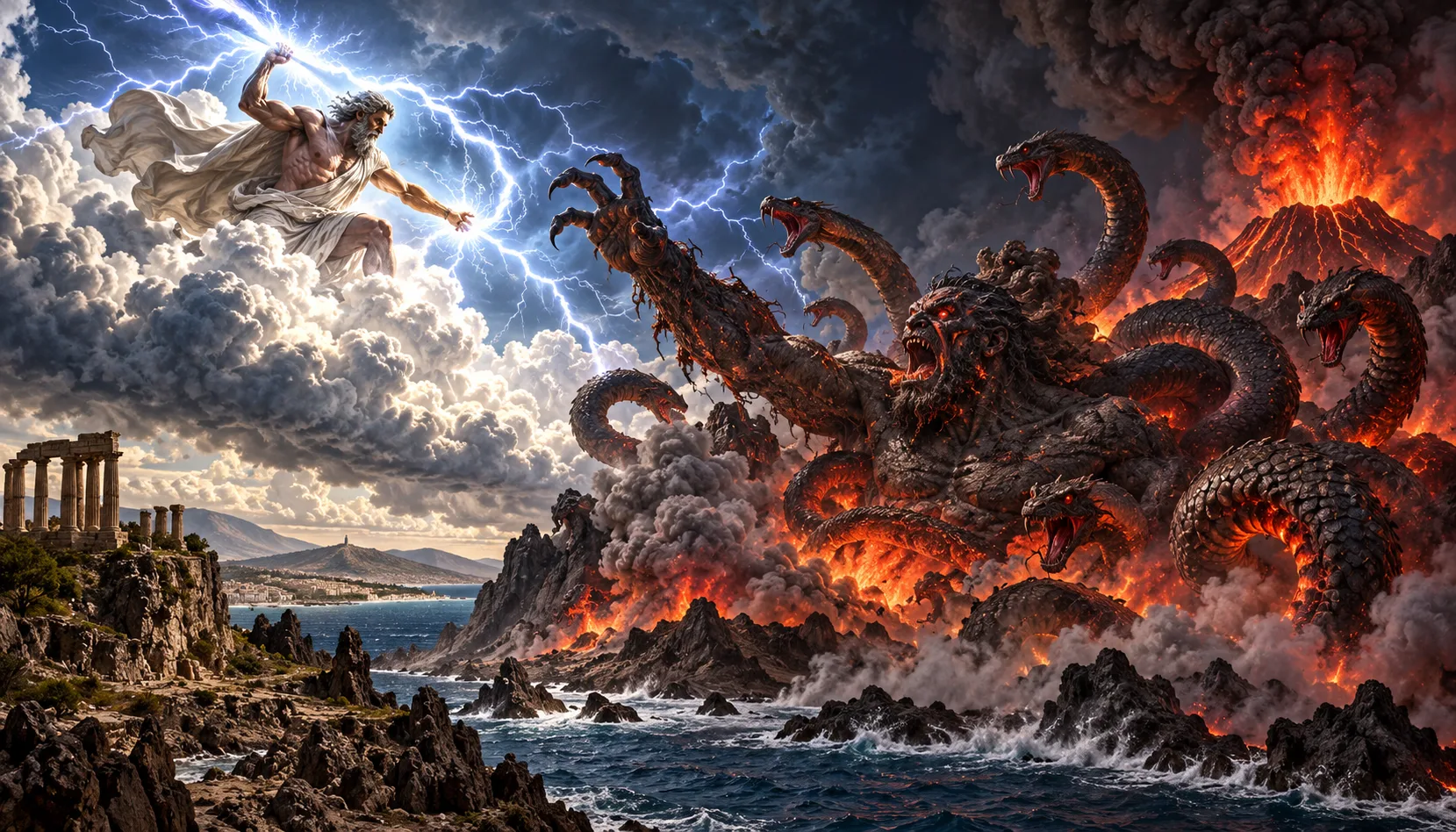
The monstrous Typhon challenges Zeus for mastery of the cosmos in one of the greatest threats to the newly established Olympian order.
Location
The geography varies substantially between ancient accounts and should not be treated as one fixed battlefield.
Sides
Zeus and the Olympian order against the monstrous Typhon, child of Gaia and Tartarus.
Forces
Primarily presented as a confrontation between Zeus and Typhon rather than conventional armies.
Objective
Typhon challenges Zeus for mastery of the cosmos and threatens the newly established Olympian order.
Source-based schematic
Battle Movement
Not to geographic scale
This diagram shows movements or positions described
in the surviving literary tradition. It does not
claim to reconstruct exact ancient battlefield
coordinates.
Illustrated interpretation of Zeus battling Typhon for mastery of the cosmos.
Ancient accounts differ substantially over the sequence and geography of the
struggle, so the landscape shown here is interpretative rather than a reconstruction
of a fixed historical battlefield.
Battle Analysis
Strategy
Zeus confronts Typhon with the divine weapons that define his kingship, especially thunder and lightning.
Tactics
Hesiod stresses repeated thunderbolt attacks and overwhelming divine fire. Other traditions make the struggle more complex and even allow Typhon a temporary advantage over Zeus.
Turning Point
Despite the scale of Typhon's challenge, Zeus regains or maintains the initiative and brings the full force of his thunderbolts against him.
Decisive Move
Zeus ultimately overwhelms Typhon with divine force and removes him as a rival for cosmic kingship.
Why did the result happen?
Typhon is powerful enough to threaten the Olympian order, but cannot permanently overcome Zeus' control of the thunderbolt and his established divine power.
Outcome
Typhon is defeated and Zeus' rule over the Olympian cosmos survives its greatest monstrous challenge.
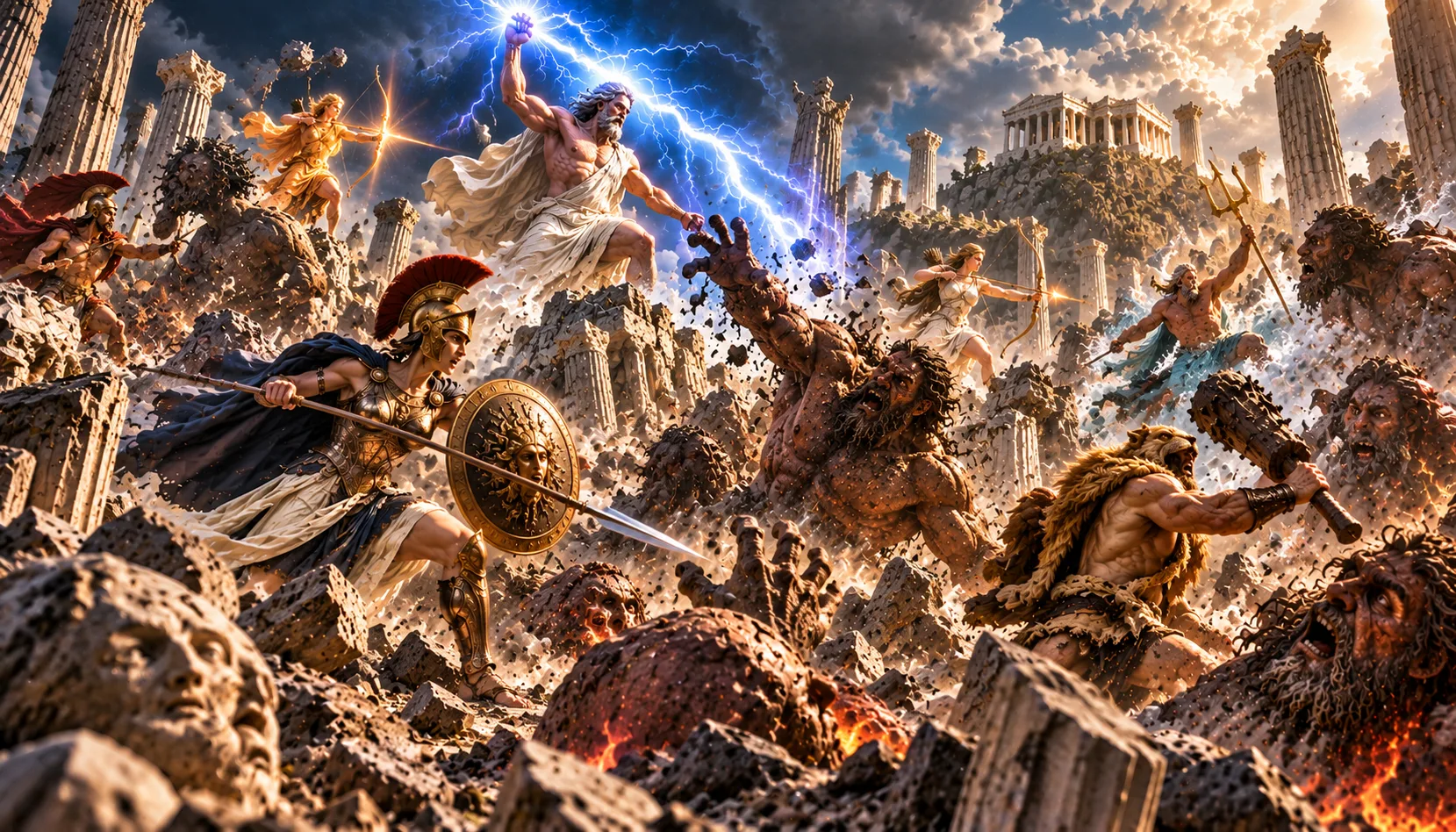
The Olympian gods fight the earth-born Giants in the Gigantomachy. A prophecy declares that the gods cannot win without the help of a mortal, making Heracles essential to the Olympian victory.
Location
Ancient traditions place the war in several locations, especially Phlegra or Pallene. No single battlefield should be treated as definitive.
Sides
The Olympian gods and the mortal hero Heracles against the earth-born Giants.
Forces
No numerical forces are preserved. The conflict is described through divine and gigantic combatants.
Objective
The Giants challenge the Olympian order, while Zeus and the gods must prevent another overthrow of the new divine regime.
Source-based schematic
Battle Movement
Not to geographic scale
This diagram shows movements or positions described
in the surviving literary tradition. It does not
claim to reconstruct exact ancient battlefield
coordinates.
Illustrated interpretation of the Gigantomachy, the great struggle between
the Olympian gods and the Giants. Ancient traditions present the conflict
as a cosmic battle rather than a geographically reconstructable campaign,
with Heracles playing a decisive mortal role alongside the gods.
Battle Analysis
Strategy
The Olympians respond to an oracle stating that the Giants cannot be destroyed by gods alone. Zeus therefore brings the mortal Heracles into the coalition.
Tactics
The war is represented as a series of linked champion engagements. The gods use their characteristic weapons while Heracles repeatedly supplies the mortal contribution required for victory.
Turning Point
Heracles joins the battle. Against Alcyoneus, Athena identifies the weakness that he cannot remain immortal once removed from his native ground.
Decisive Move
Heracles drags Alcyoneus beyond his native territory and kills him, while Zeus and Heracles combine against Porphyrion and the other gods defeat individual Giants.
Why did the result happen?
The Olympians succeed because they recognise that divine power alone cannot satisfy the prophecy. Heracles' mortal participation changes the strategic balance.
Outcome
The Giants are defeated and the Olympian order survives another major challenge to its authority.
Major conflicts of the Heroic Age outside the Trojan and Theban war cycles.
Heroic Close-Combat Battle
The Centauromachy
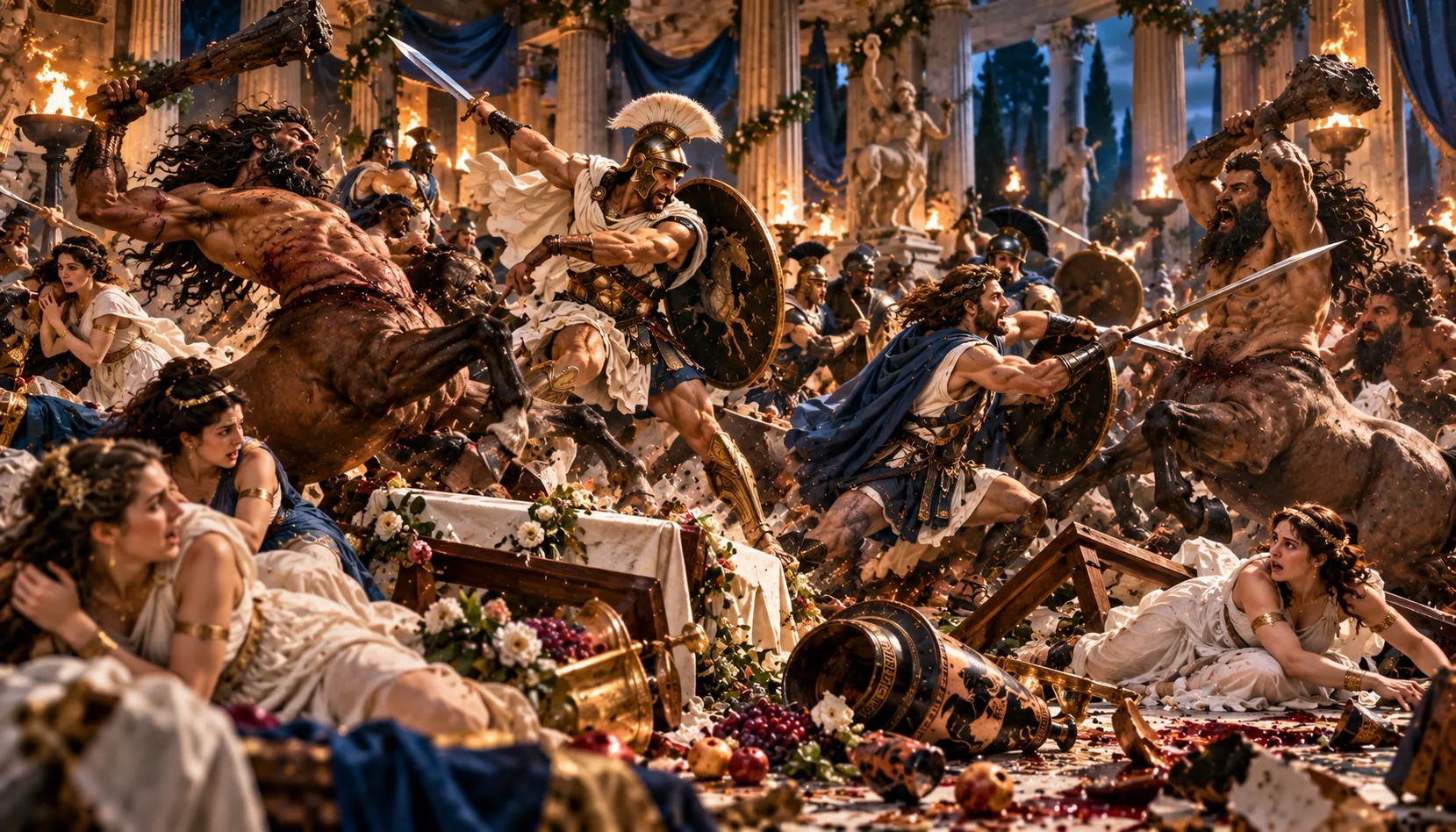
The Centauromachy is the violent battle between the Lapiths and the Centaurs that erupts during the wedding of Pirithous. Theseus joins the Lapiths as the celebration turns into one of Greek mythology's most famous close-combat conflicts.
Lapith territory in Thessaly, traditionally during the wedding feast of Pirithous and Hippodamia.
Sides
The Lapiths and their heroic allies, including Theseus, against the Centaurs attending the wedding.
Forces
No reliable numbers are preserved. Ancient traditions name numerous individual Lapith and Centaur combatants.
Objective
The battle is not planned in advance. The Lapiths seek to protect the bride and wedding guests after violence erupts during the feast.
Source-based schematic
Battle Movement
Not to geographic scale
This diagram shows movements or positions described
in the surviving literary tradition. It does not
claim to reconstruct exact ancient battlefield
coordinates.
Illustrated interpretation of the Centauromachy, the violent clash between
the Lapiths and Centaurs at the wedding feast of Pirithous and Hippodamia.
Theseus fights alongside the Lapiths as the celebration descends into battle.
Battle Analysis
Strategy
Neither side begins with a conventional battlefield plan because the conflict develops suddenly from a feast.
Tactics
The surviving tradition emphasises close combat. Combatants use ordinary weapons as well as objects available within the wedding setting.
Turning Point
The Lapiths and their heroic allies recover from the initial surprise and organise effective resistance.
Decisive Move
Sustained Lapith resistance, strengthened by heroes such as Theseus and Pirithous, breaks the Centaur attack.
Why did the result happen?
The Centaurs gain surprise but fail to convert it into a durable tactical advantage. Once the Lapiths organise, the attackers are progressively defeated.
Outcome
The Lapiths win and the surviving Centaurs are driven away from the region in the wider tradition.
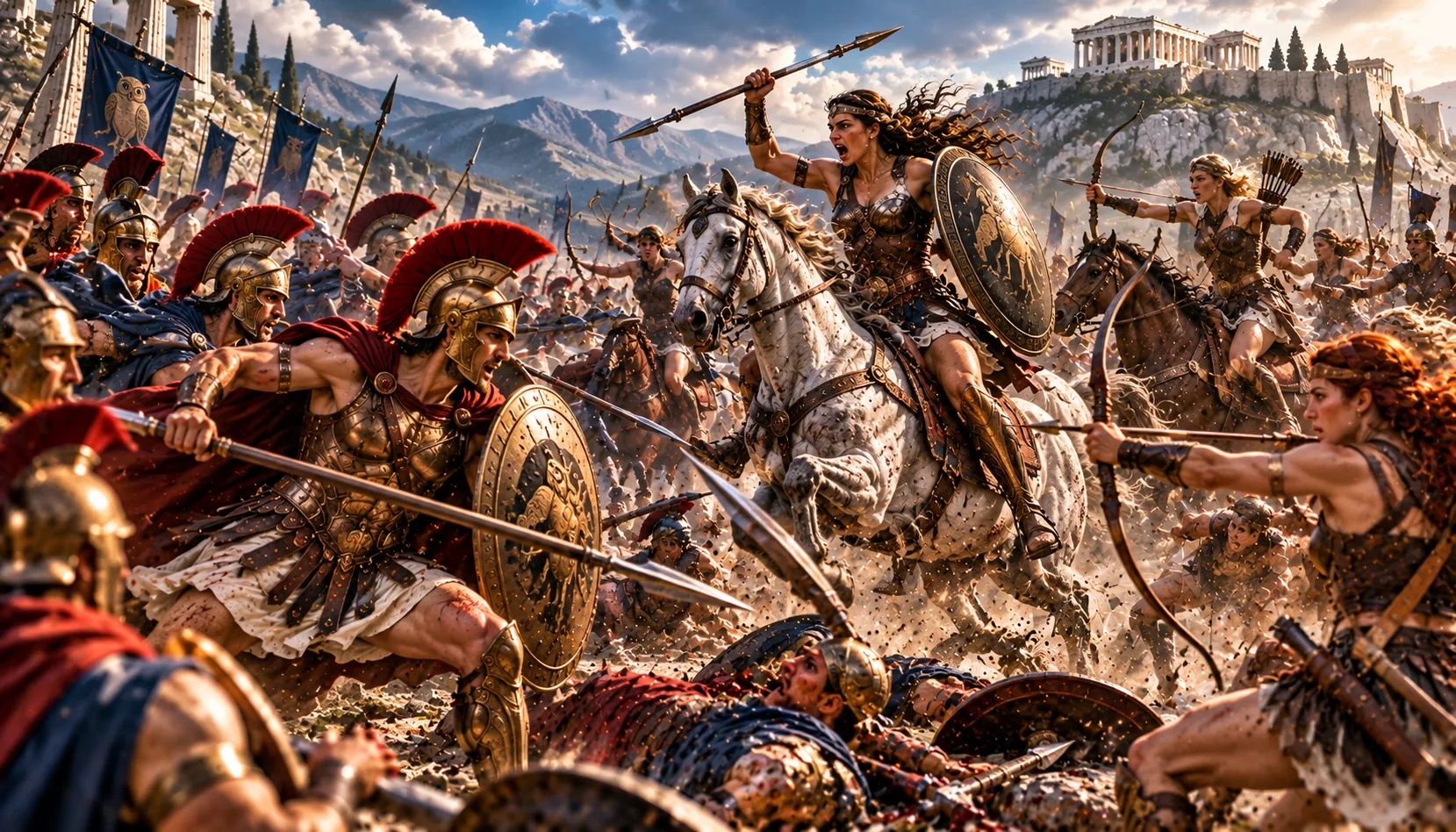
The Amazons invade Attica and fight the Athenians under Theseus in the Amazonomachy. The conflict is connected with Theseus' relationship with Antiope or Hippolyta and with earlier Greek expeditions against the Amazons.
Athens and Attica. Ancient traditions remember Amazon positions near the city but differ over exact deployment.
Sides
The Amazons against the Athenians led by Theseus.
Forces
No trustworthy troop totals survive. Ancient accounts describe a substantial Amazon force invading Attica.
Objective
The Amazons invade Attica in traditions connected with Theseus and Antiope or Hippolyta and with earlier Greek actions against the Amazons.
Source-based schematic
Battle Movement
Not to geographic scale
This diagram shows movements or positions described
in the surviving literary tradition. It does not
claim to reconstruct exact ancient battlefield
coordinates.
Illustrated interpretation of the Amazonomachy, the legendary conflict
between Greek warriors and the Amazons. Theseus is closely associated
with the Athenian tradition of the battle, which became a major theme
in Greek art and mythology.
Battle Analysis
Strategy
Rather than waiting for another Greek expedition, the Amazons carry the war directly into Greece and advance to Athens.
Tactics
The sources describe Amazon positions close to Athens followed by direct battle with Theseus and the Athenians.
Turning Point
Theseus brings the Athenian defence into decisive combat after the Amazons penetrate deeply into Attica.
Decisive Move
The Athenian counterattack breaks the Amazon invasion and forces the survivors away from the city.
Why did the result happen?
The Amazons successfully reach Athens but cannot turn their invasion into permanent control of the city.
Outcome
Theseus and the Athenians win and the surviving Amazons withdraw from Attica.
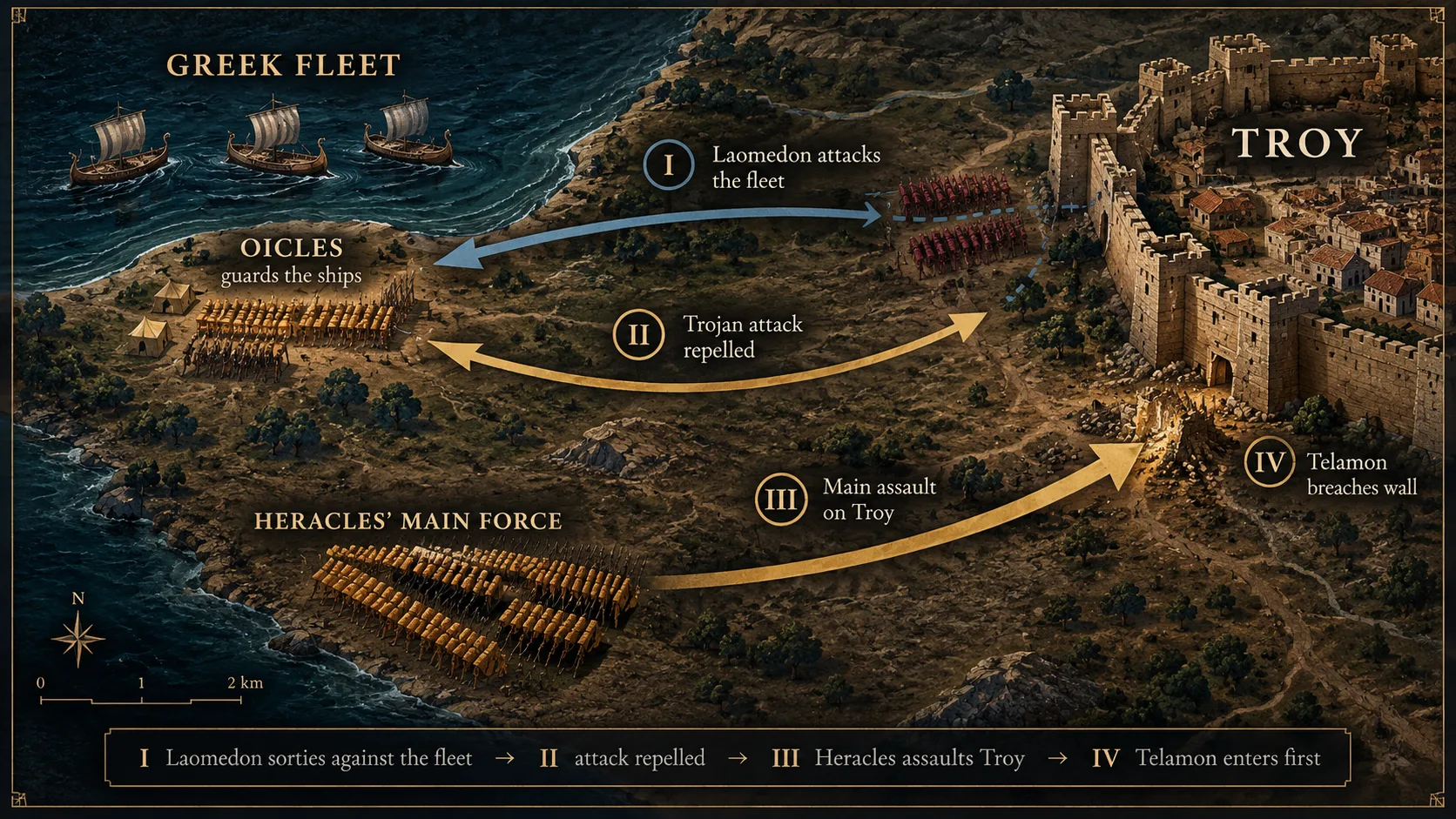
Heracles and a volunteer expedition including Telamon against King Laomedon and the Trojans.
Forces
Apollodorus gives Heracles eighteen ships, each described as having fifty oars. The number of Trojan defenders is not preserved.
Objective
Heracles returns to punish Laomedon for breaking his promise of reward and intends to capture Troy.
Source-based schematic
Battle Movement
Not to geographic scale
This diagram shows movements or positions described
in the surviving literary tradition. It does not
claim to reconstruct exact ancient battlefield
coordinates.
Illustrated interpretation of the campaign described by Apollodorus.
The terrain and positions are schematic rather than a reconstruction
of exact battlefield geography.
Based on Apollodorus, Library 2.6.4.
Battle Analysis
Strategy
After landing, Heracles leaves Oicles to guard the ships while the main force advances inland against the city. This divides the expedition between its naval base and assault force.
Tactics
Laomedon attempts to exploit that division by attacking the ships. Oicles is killed, but Heracles' men repel Laomedon. The Greeks then press the attack into a formal siege of Troy.
Turning Point
Laomedon's attack on the ships fails to destroy Heracles' expedition, allowing the attackers to maintain the siege.
Decisive Move
Telamon is the first attacker to breach the wall and enter Troy, with Heracles following him into the city.
Why did the result happen?
The Trojan counterattack fails to eliminate the invading force or its ability to continue the siege. Once the wall is breached, Troy loses the protection of its fortifications.
Outcome
Troy is captured and sacked. Laomedon and most of his sons are killed; Priam survives and later becomes king of the rebuilt city.
Apollodorus, Library 2.6.4. The eighteen ships and fifty-oared description are ancient source details; they should not be converted directly into an assumed total number of combat troops.
The Argive-led coalition supporting Polynices against the Thebans commanded by Eteocles.
Forces
Total army strengths are not preserved. The famous structure of the assault centres on seven leading Argive champions and the seven gates of Thebes.
Objective
Polynices and his allies seek to seize Thebes and enforce his claim against his brother Eteocles.
Source-based schematic
Battle Movement
Not to geographic scale
This diagram shows movements or positions described
in the surviving literary tradition. It does not
claim to reconstruct exact ancient battlefield
coordinates.
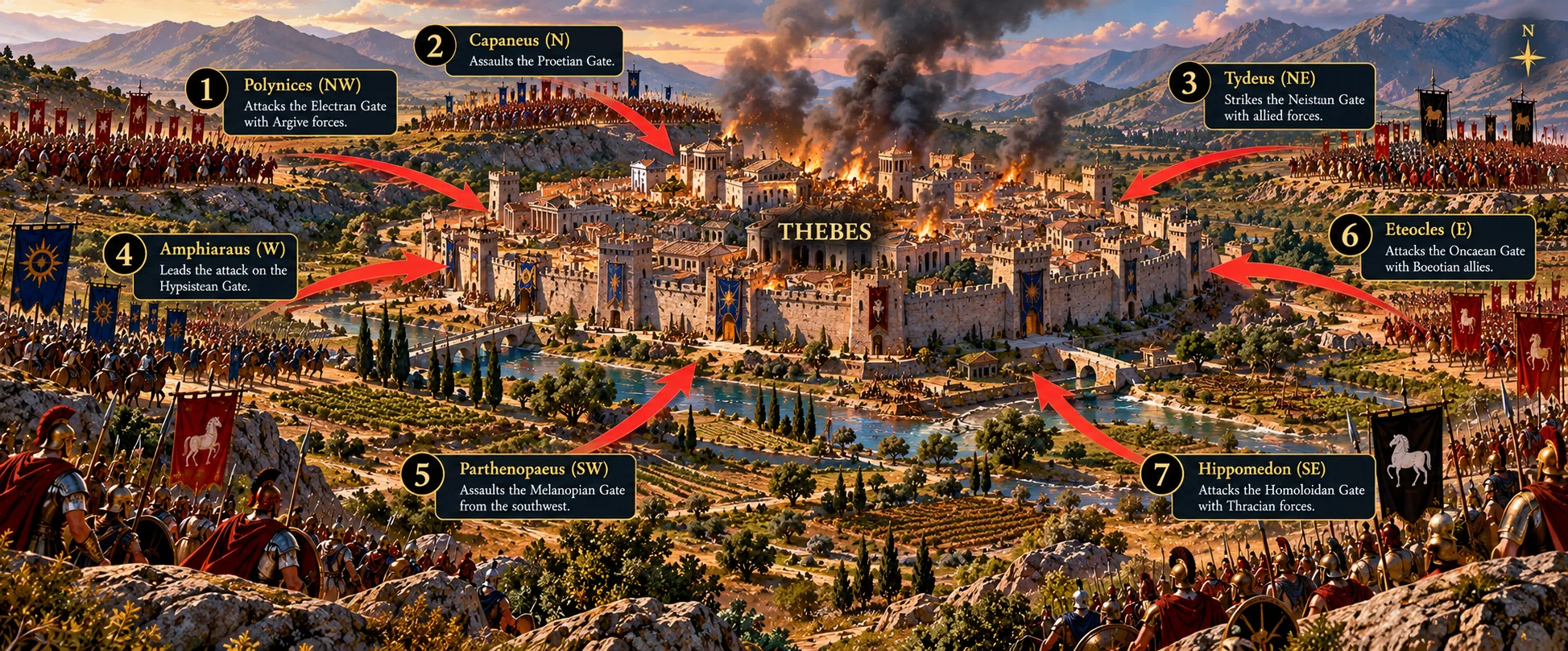
Illustrated interpretation of the assault on the seven gates of Thebes.
Positions and terrain are schematic, reflecting the surviving literary tradition
rather than exact battlefield geography.
Based primarily on Aeschylus,
Seven Against Thebes.
Gate assignments vary between ancient accounts.
Battle Analysis
Strategy
The attackers divide their principal commanders among the city's seven gates. In Aeschylus, the assignments are made by lot, creating simultaneous pressure around the fortified perimeter.
Tactics
Eteocles does not defend blindly. He sends scouts to observe the Argive army, receives reports on each attacking champion and selects a Theban defender for each gate. The walls, battlements, towers and gate approaches form the core of the defensive system.
Turning Point
The coordinated assault fails to produce a general breach. Individual contests at the gates and divine intervention destroy or neutralise several of the leading attackers.
Decisive Move
There is no single tactical stroke comparable with a battlefield flanking manoeuvre. The decisive factor is that the Theban defensive line continues to hold across the gates while the attacking champions are progressively lost.
Why did the result happen?
Thebes benefits from strong fortifications, advance intelligence and a gate-by-gate defensive response. The attacking coalition never converts its seven-gate plan into a successful capture of the city.
Outcome
The assault fails. Eteocles and Polynices kill one another at the seventh gate, leaving Thebes intact but its ruling brothers dead.
Aeschylus, Seven Against Thebes, especially the scout and seven-gate sequence. Ancient authors vary over the precise list of champions and gate assignments.
The Epigoni and their Argive allies under Alcmaeon against the Theban / Cadmean forces.
Forces
Diodorus describes Alcmaeon assembling soldiers from Argos and neighbouring cities and calls the result a notable army, but gives no numerical strength.
Objective
The sons of the earlier Seven seek to avenge their fathers and succeed in the campaign against Thebes that the previous generation failed to win.
Source-based schematic
Battle Movement
Not to geographic scale
This diagram shows movements or positions described
in the surviving literary tradition. It does not
claim to reconstruct exact ancient battlefield
coordinates.
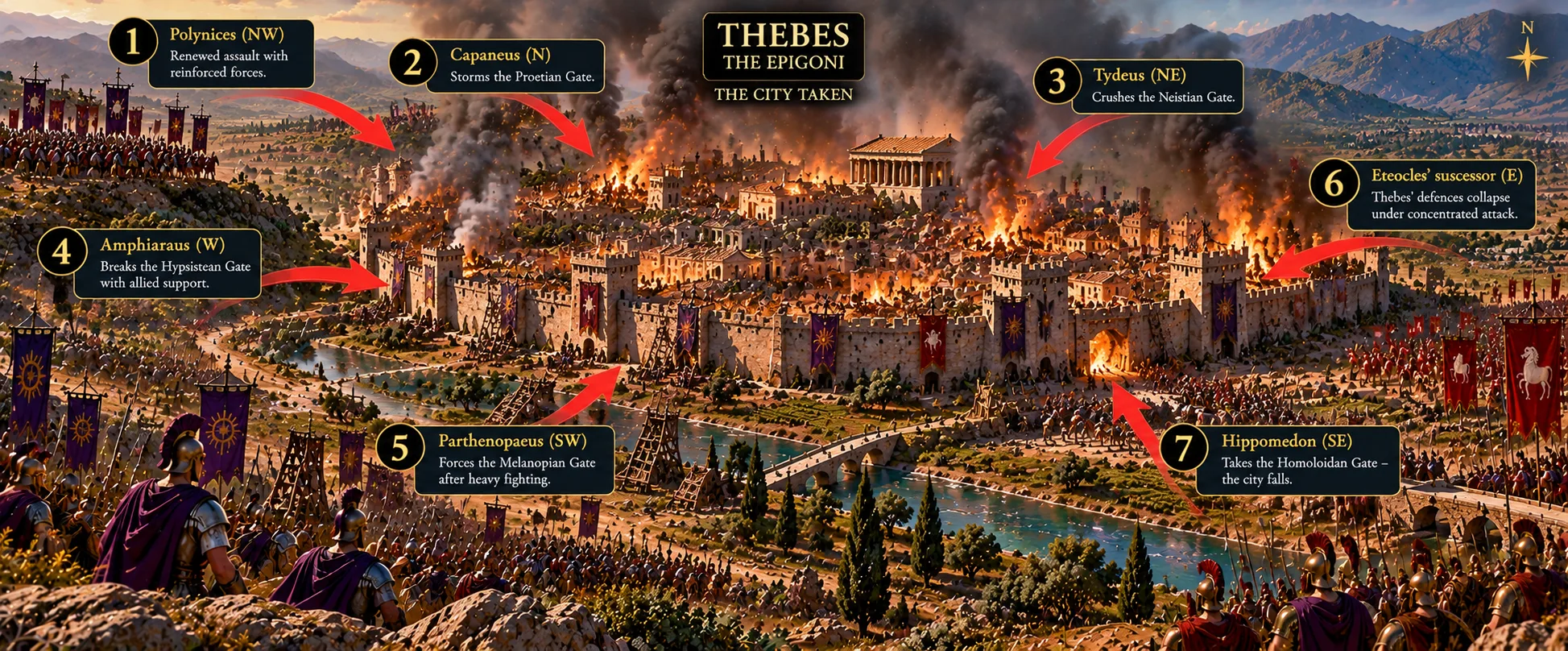
Illustrated interpretation of the Epigoni campaign and renewed assault on Thebes.
Terrain, troop positions and movements are schematic rather than exact battlefield geography.
Based on Apollodorus and Diodorus Siculus'
accounts of the Epigoni.
Battle Analysis
Strategy
Unlike the earlier assault remembered for its seven gate commanders, the surviving account emphasises the concentration of a larger allied army under a single supreme commander, Alcmaeon.
Tactics
The decisive action is fought as a major field battle between the Epigoni and the Theban army rather than being remembered primarily as another prolonged gate assault.
Turning Point
The Theban army is decisively defeated and loses many citizens. The surviving defenders no longer believe they can offer effective resistance.
Decisive Move
The Epigoni's victory in open battle makes continued defence of Thebes strategically untenable.
Why did the result happen?
The second generation achieves what the Seven could not: a decisive battlefield victory before attempting to occupy the city. Once the field army is broken, Thebes loses the force needed to sustain resistance.
Outcome
On the advice of Teiresias, the Thebans evacuate during the night. The Epigoni enter and sack the abandoned city.
Battles, duels and strategic operations from the first failed expedition through the destruction of Troy.
Early Trojan Expedition
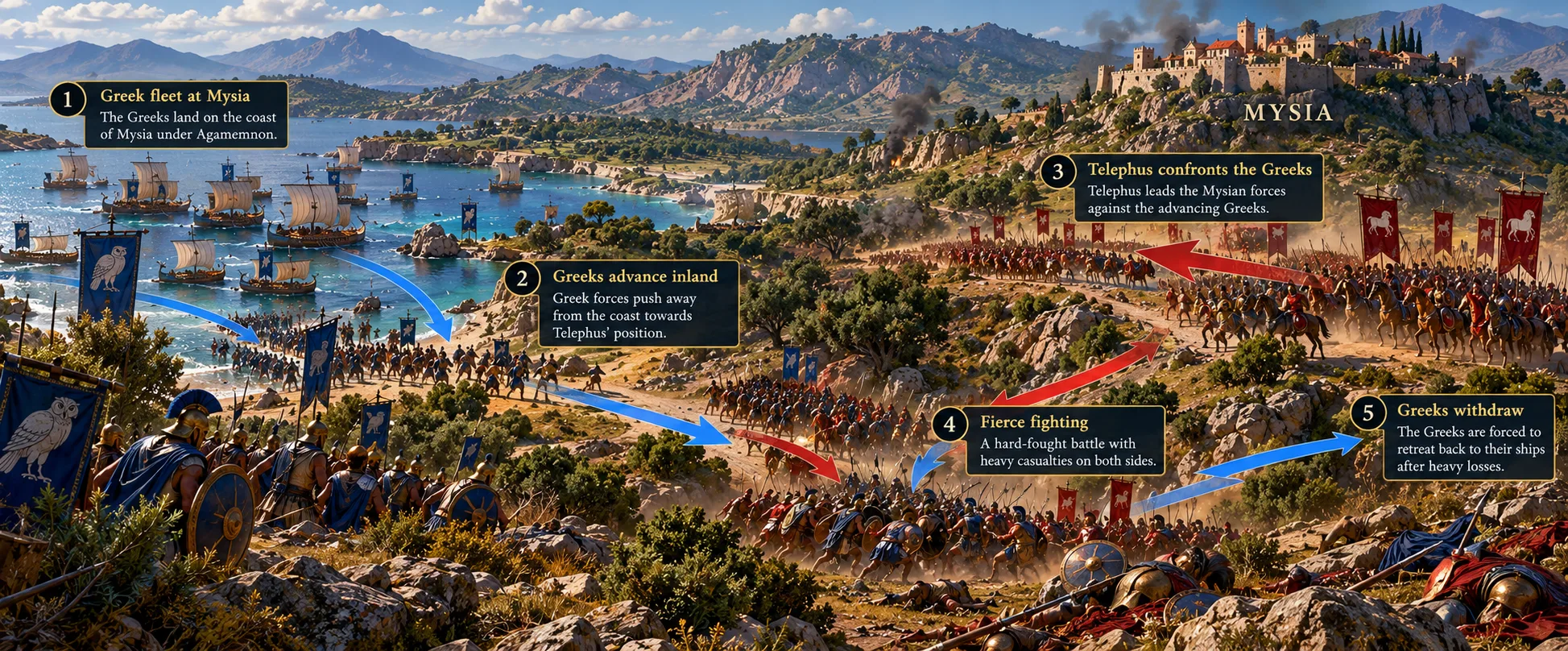
Telephus and the Greeks in Mysia
Before reaching Troy, the Greek expedition lands in Mysia, fights King Telephus and discovers that Achilles' wound will become part of the route to Troy.
Greek expedition under Agamemnon, with Achilles among its leading warriors, against the Mysians under King Telephus.
Forces
Exact numbers are not preserved. The tradition describes a substantial Greek expedition and a Mysian force mobilised by Telephus.
Objective
The Greeks mistakenly believe they have reached Troy and begin ravaging Mysia. Telephus' immediate objective is therefore to expel an invading army from his kingdom.
Source-based schematic
Battle Movement
Not to geographic scale
This diagram shows movements or positions described
in the surviving literary tradition. It does not
claim to reconstruct exact ancient battlefield
coordinates.
Illustrated interpretation of the Greek landing and battle with Telephus in Mysia.
Terrain and troop positions are schematic rather than exact battlefield coordinates.
Based on Apollodorus, Epitome 3.17–18.
Battle Analysis
Strategy
Telephus responds aggressively rather than remaining behind fortifications. He arms the Mysians and counterattacks the invading Greeks, attempting to drive them all the way back to their ships.
Tactics
The battle develops into a hard pursuit. Telephus kills several Greeks and initially forces the Greek line backwards. Achilles then enters the fighting against Telephus personally and reverses the local momentum.
Turning Point
As Telephus retreats from Achilles, he becomes entangled in a vine. The loss of mobility leaves him exposed to Achilles' attack.
Decisive Move
Achilles wounds Telephus in the thigh with his spear, removing the Mysian king from effective combat.
Why did the result happen?
Telephus' counterattack is initially successful, but the Greeks possess Achilles, whose intervention turns the decisive personal engagement. The episode does not produce a conventional Greek conquest: the expedition withdraws after discovering its mistake.
Outcome
The Greeks leave Mysia. Telephus survives but remains wounded, and his later healing becomes connected with the Greeks' eventual route to Troy.
The Greeks, with Diomedes supported by Athena, against Trojan forces and gods who intervene in battle.
Forces
Overall army strengths are not preserved in a form that allows reliable numerical reconstruction.
Objective
The Greeks seek to regain battlefield momentum while Diomedes becomes the spearhead of an exceptionally aggressive offensive.
Source-based schematic
Battle Movement
Not to geographic scale
This diagram shows movements or positions described
in the surviving literary tradition. It does not
claim to reconstruct exact ancient battlefield
coordinates.
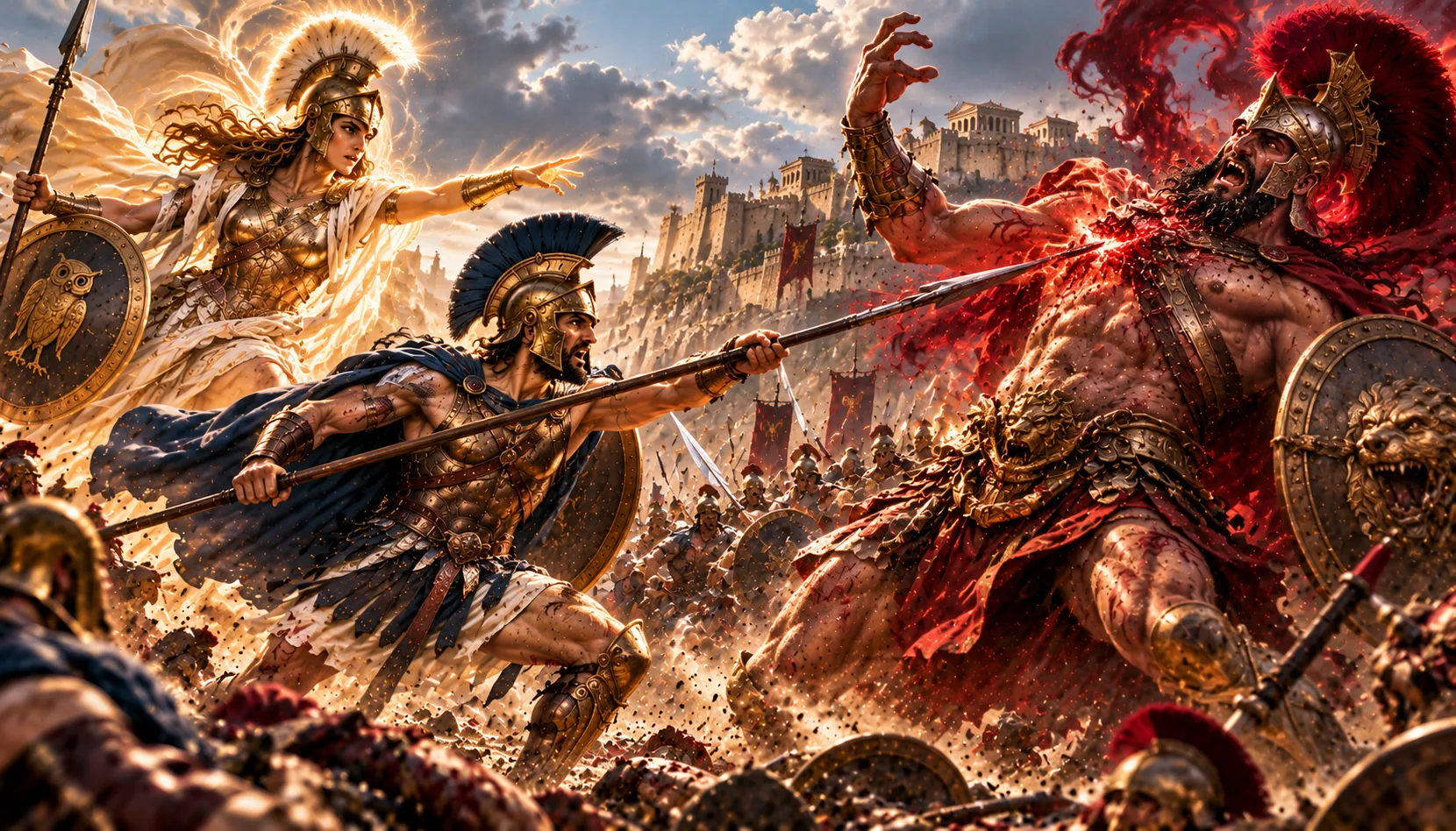
Illustrated interpretation of Diomedes' extraordinary aristeia in Book 5
of the Iliad. With Athena guiding his attack, the mortal warrior strikes
and wounds Ares — one of the most dramatic encounters between a human
warrior and an Olympian god in the Trojan War tradition.
Battle Analysis
Strategy
Athena concentrates extraordinary combat effectiveness in a single champion, allowing Diomedes to distinguish himself against both mortal and divine opponents.
Tactics
Diomedes attacks aggressively through the Trojan line, wounds Aeneas, confronts Aphrodite when she attempts a rescue, and later attacks Ares with Athena's direct aid.
Turning Point
Divine intervention does not stop Diomedes. Instead, Athena's participation allows the Greek champion to challenge gods who have entered the fighting.
Decisive Move
Athena assists Diomedes directly against Ares, turning a mortal attack into a successful strike against the war god himself.
Why did the result happen?
Diomedes' success comes from the combination of personal aggression and unusually direct divine support.
Outcome
Diomedes temporarily dominates the battlefield and forces even divine participants such as Aphrodite and Ares out of the immediate fighting.
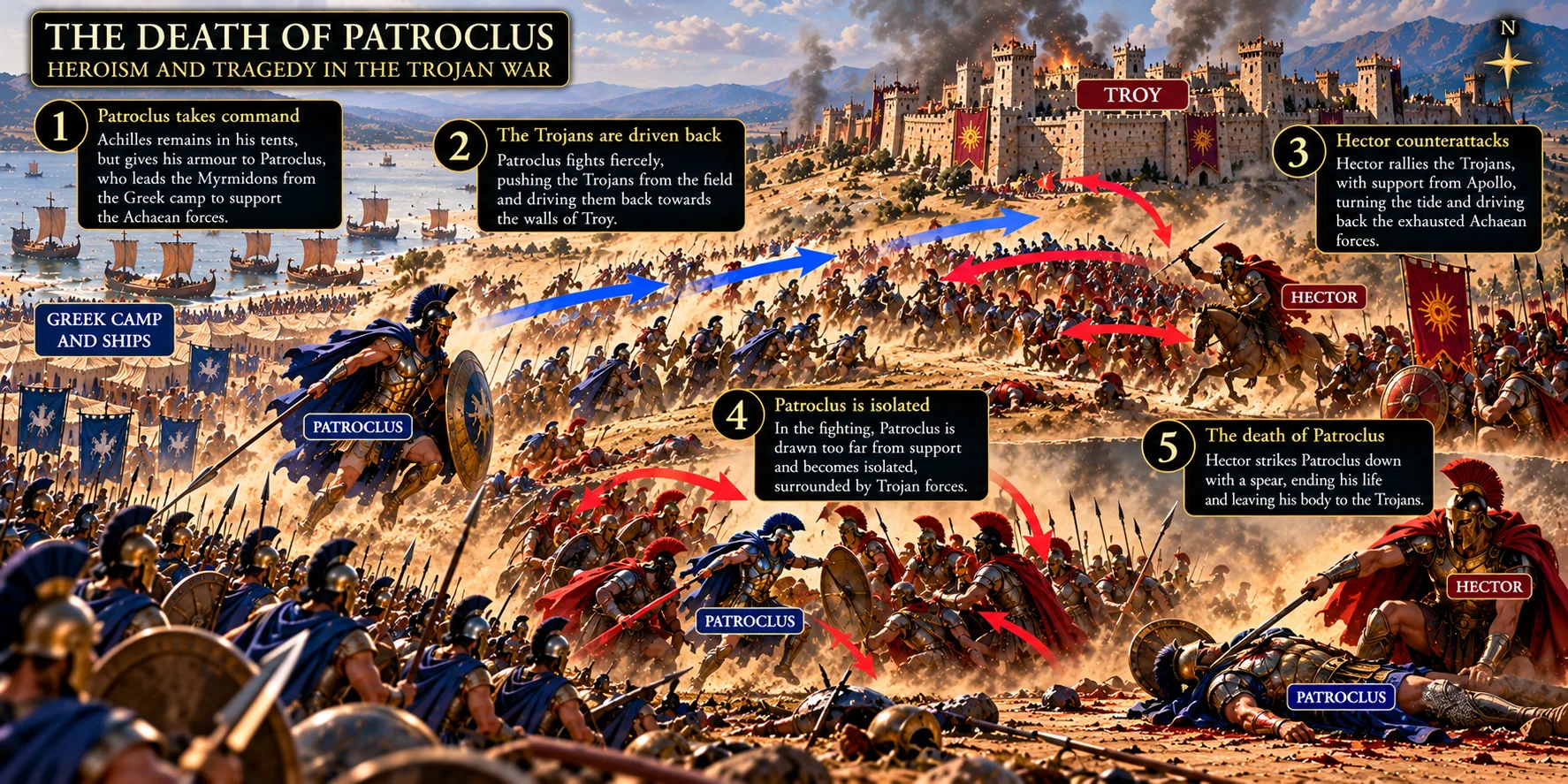
Patroclus enters battle wearing Achilles' armour and is killed by Hector, forcing Achilles to confront the consequences of his withdrawal from the war.
Patroclus and the Myrmidons fighting for the Greeks against Hector, the Trojans and their allies.
Forces
No reliable total strengths are preserved. Patroclus leads the Myrmidons as part of the larger Greek army.
Objective
Achilles sends Patroclus out primarily to save the Greek ships from destruction and drive the Trojans away.
Source-based schematic
Battle Movement
Not to geographic scale
This diagram shows movements or positions described
in the surviving literary tradition. It does not
claim to reconstruct exact ancient battlefield
coordinates.
Illustrated interpretation of Patroclus' counterattack, the Trojan response and his death.
Movements and positions are schematic, following the literary tradition rather than exact battlefield geography.
Based on Homer, Iliad Book 16.
Battle Analysis
Strategy
Patroclus wears Achilles' armour, creating the impression that Achilles himself may have returned to battle.
Tactics
The counterattack succeeds beyond its original purpose. Patroclus drives the Trojans from the ships, kills Sarpedon and continues the pursuit toward Troy.
Turning Point
Patroclus exceeds Achilles' instruction to return once the ships are safe and presses the attack against Troy. Apollo repeatedly prevents him from storming the wall.
Decisive Move
Apollo strikes and disorients Patroclus and strips away his effective defence; Euphorbus wounds him, and Hector then delivers the fatal spear thrust.
Why did the result happen?
Patroclus' initial counterattack is extremely successful, but continued pursuit takes him beyond the limited mission Achilles gave him and exposes him to divine and Trojan counteraction.
Outcome
Patroclus dies. His death causes Achilles to abandon his withdrawal from the war and return specifically to seek vengeance against Hector.
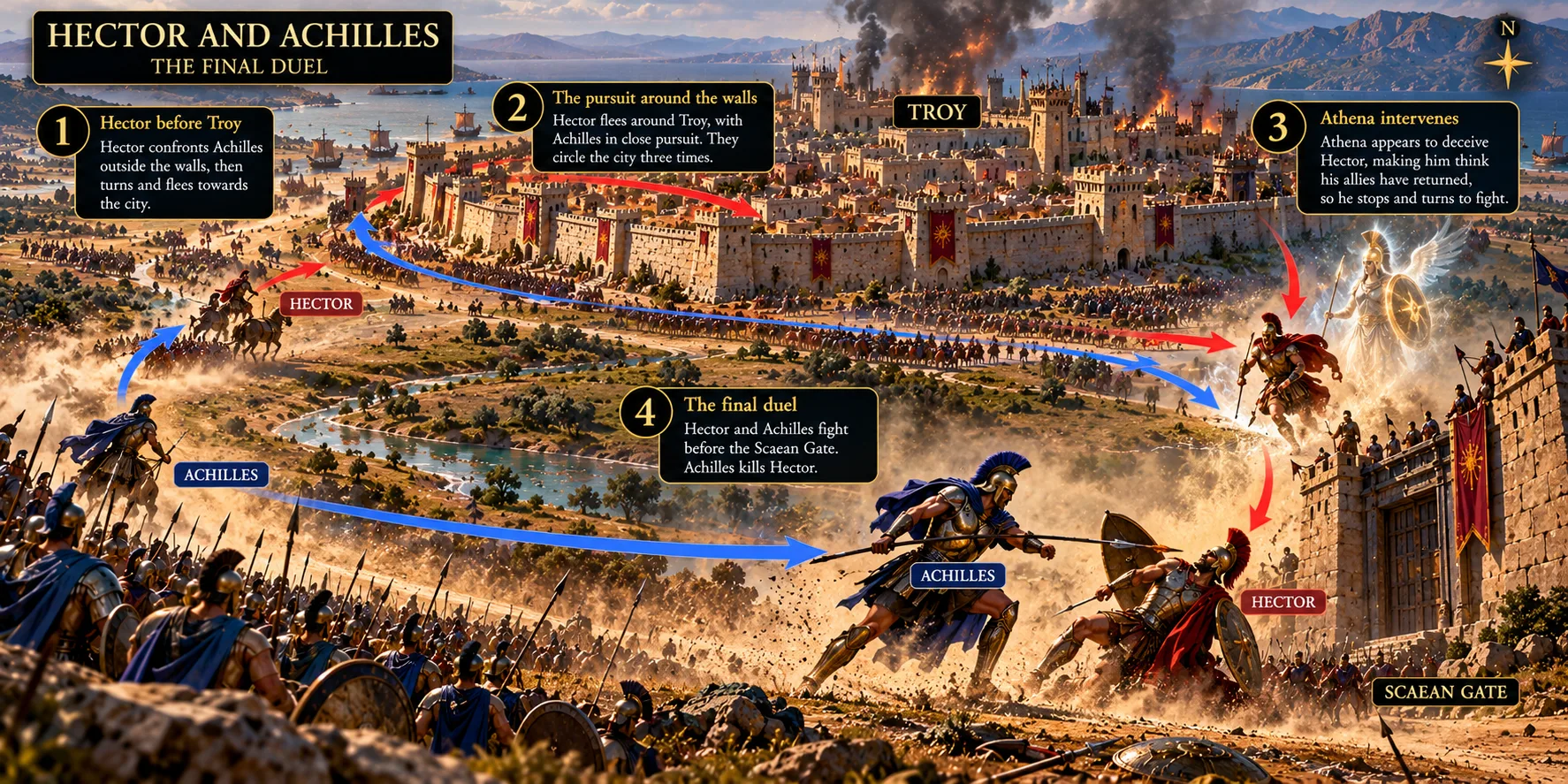
Achilles of the Greek army against Hector, prince and principal battlefield defender of Troy.
Forces
One warrior against one warrior in the decisive duel, although both belong to much larger armies watching or affected by the outcome.
Objective
Achilles seeks vengeance for Patroclus and intends to kill Hector. Hector ultimately chooses to stand and fight rather than continue avoiding Achilles.
Source-based schematic
Battle Movement
Not to geographic scale
This diagram shows movements or positions described
in the surviving literary tradition. It does not
claim to reconstruct exact ancient battlefield
coordinates.
Illustrated interpretation of Hector's flight around Troy and his final confrontation with Achilles.
Movements and terrain are schematic, following the literary tradition rather than exact battlefield geography.
Based on Homer, Iliad Book 22.
Battle Analysis
Strategy
Hector initially refuses the direct engagement and runs around Troy while Achilles pursues him. Athena then intervenes by taking the appearance of Hector's brother Deiphobus and persuading Hector that he will have support in a stand.
Tactics
The duel begins with thrown spears. Achilles' first cast misses but Athena secretly returns the weapon to him. Hector's spear strikes Achilles' divine shield but fails to penetrate it. Hector then loses the ability to obtain another spear and closes with his sword.
Turning Point
Hector discovers that the apparent Deiphobus is not beside him and realises Athena has deceived him. He is now committed to the duel without the support he believed he had.
Decisive Move
Achilles identifies an exposed area around Hector's neck above the armour and drives his spear through it.
Why did the result happen?
Achilles combines exceptional fighting ability with divine assistance. Athena both induces Hector to stop fleeing and restores Achilles' spear, while Hector's own attack cannot penetrate Achilles' armour.
Outcome
Hector is killed. Troy loses its most important battlefield defender, while Achilles' treatment of Hector's body creates the final moral crisis of the Iliad.
Homer, Iliad Book 22. This is unusually detailed single-combat evidence, but should not be treated as a historical reconstruction of Bronze Age warfare.
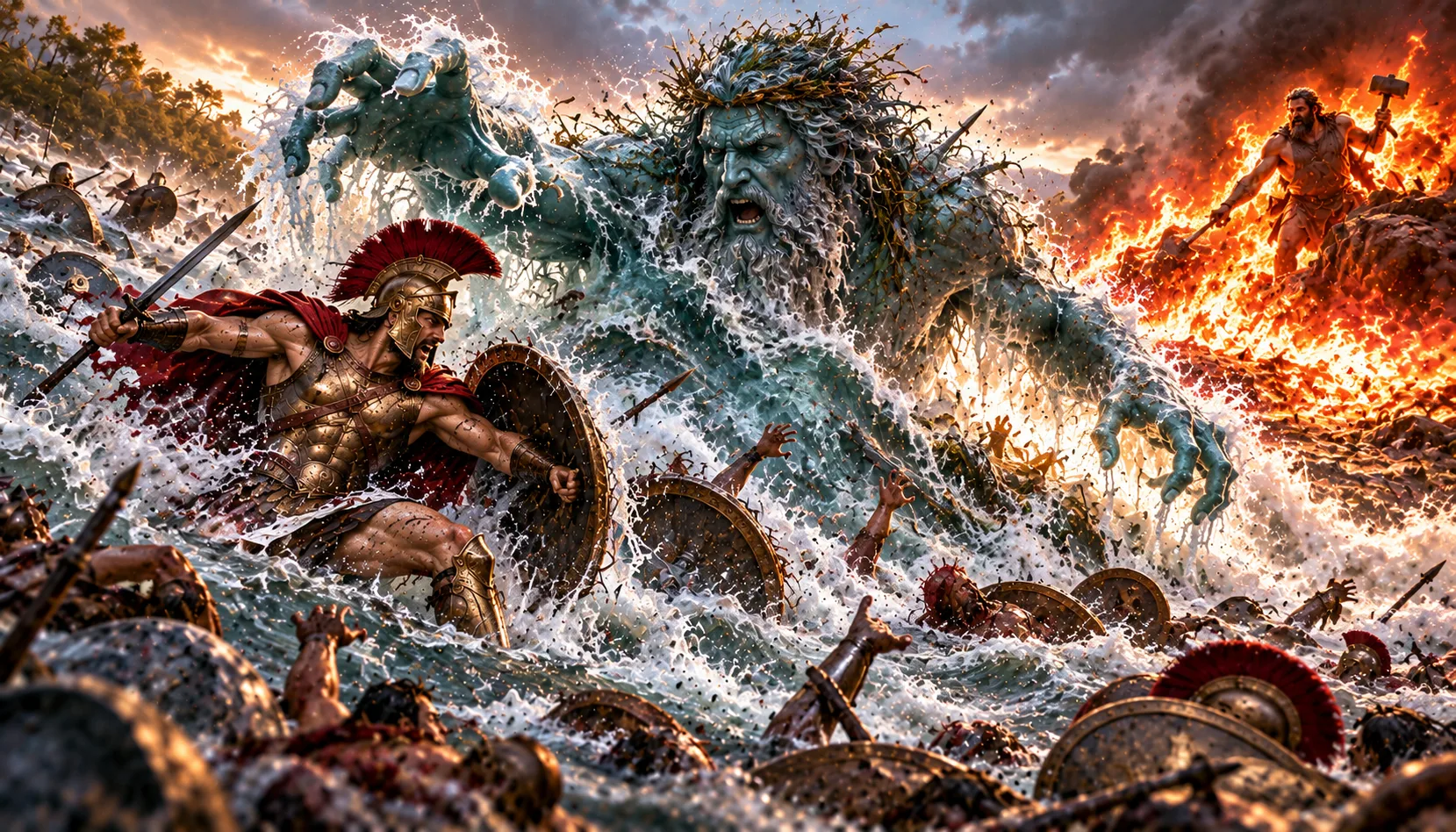
Achilles against the river god Scamander, with divine intervention from Hephaestus and Hera.
Forces
Not a conventional battle between armies. The conflict develops from Achilles' pursuit and killing of Trojans in and around the river.
Objective
Achilles continues his attempt to destroy the fleeing Trojans, while Scamander seeks to stop the slaughter and protect his river from the bodies choking its waters.
Source-based schematic
Battle Movement
Not to geographic scale
This diagram shows movements or positions described
in the surviving literary tradition. It does not
claim to reconstruct exact ancient battlefield
coordinates.
Illustrated interpretation of Achilles' struggle with the river god
Scamander in Book 21 of the Iliad. The river rises against Achilles
and threatens to overwhelm him before Hephaestus intervenes with
divine fire, forcing Scamander to yield.
Battle Analysis
Strategy
Scamander turns the terrain itself against Achilles, using surging water rather than conventional weapons.
Tactics
The river rises, sweeps corpses away, conceals living Trojans and threatens to overwhelm Achilles with floodwater.
Turning Point
The river nearly neutralises Achilles until Hera orders Hephaestus to intervene.
Decisive Move
Hephaestus attacks the river with supernatural fire, burning vegetation and heating the water until Scamander agrees to stop fighting Achilles.
Why did the result happen?
Achilles cannot overcome the river through ordinary martial strength. He survives because divine fire is used to counter the river's elemental power.
Outcome
Scamander withdraws from the struggle and Achilles continues his pursuit of the Trojans toward the city.
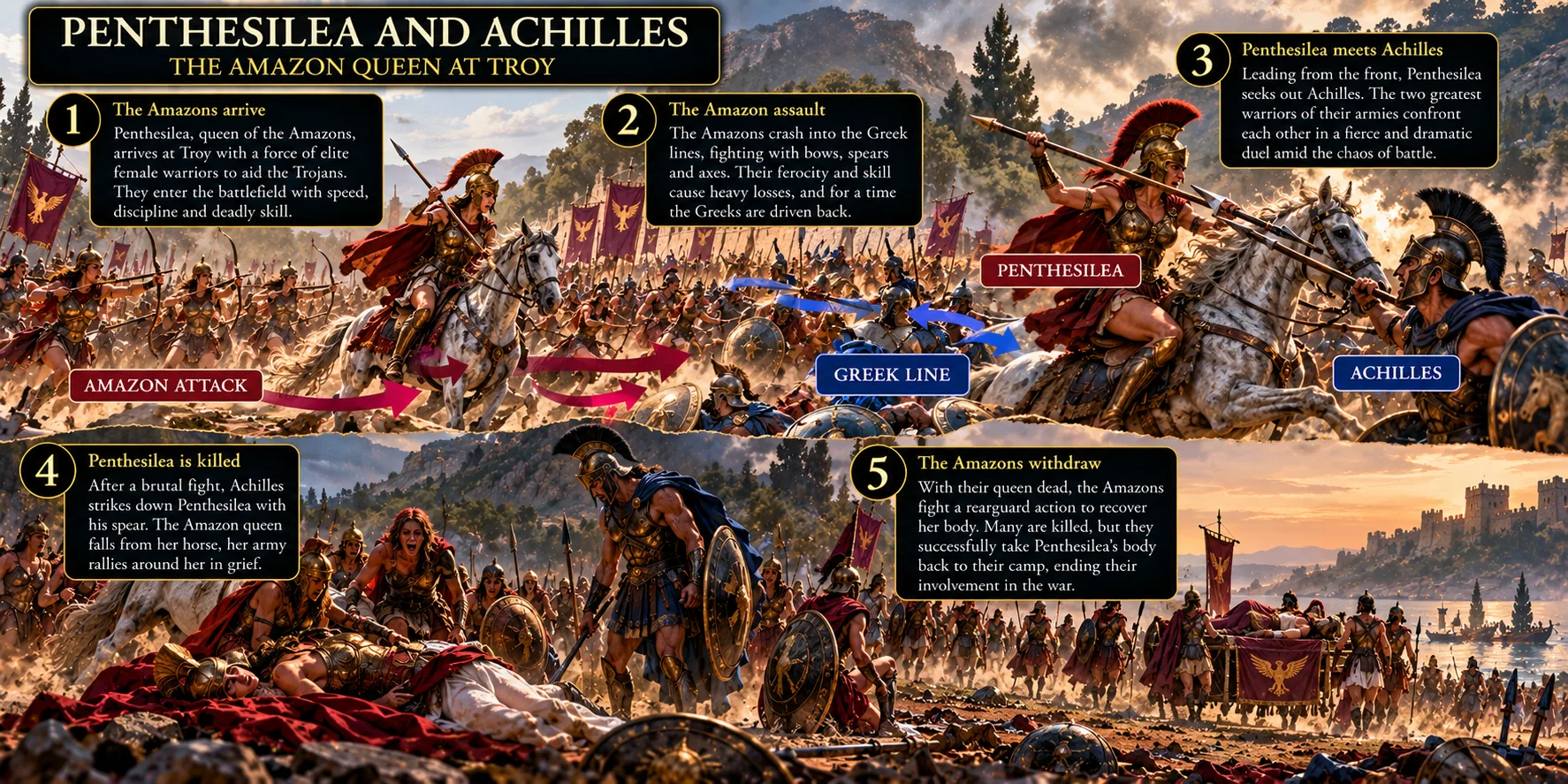
The Amazon queen Penthesilea comes to defend Troy after Hector's death and meets Achilles in one of the great episodes of the lost Trojan epic tradition.
Penthesilea and her Amazons fighting alongside the Trojans against the Greek army, including Achilles and Ajax.
Forces
No reliable total army strengths are preserved. Later epic tradition presents Penthesilea with an Amazon contingent supporting Troy.
Objective
Penthesilea arrives after Hector's death to reinforce a badly weakened Troy and drive the Greeks away from the city.
Source-based schematic
Battle Movement
Not to geographic scale
This diagram shows movements or positions described
in the surviving literary tradition. It does not
claim to reconstruct exact ancient battlefield
coordinates.
Illustrated interpretation of Penthesilea's Amazon assault and her final encounter with Achilles.
Movements and positions are schematic, following the surviving literary tradition.
Battle Analysis
Strategy
The Amazon queen takes an aggressively offensive role. In Quintus Smyrnaeus, her attack restores Trojan confidence and carries the fighting toward the Greek ships rather than remaining behind Troy's walls.
Tactics
The account emphasises rapid heroic attacks and the ability of Penthesilea to break through individual Greek opponents. The battle changes when Achilles and Ajax enter the fighting.
Turning Point
The arrival of Achilles and Ajax stops the momentum created by Penthesilea's attack.
Decisive Move
Ajax turns back toward the wider Trojan force while Achilles engages Penthesilea directly and kills her in single combat.
Why did the result happen?
The Amazon intervention temporarily changes the battlefield situation, but Troy cannot neutralise the Greeks' strongest champions. Once Achilles enters the central fight, Penthesilea's offensive loses its principal commander.
Outcome
Penthesilea is killed and the Amazon reinforcement fails to alter the long-term balance of the Trojan War.
The detailed surviving battle narrative comes mainly from Quintus Smyrnaeus, Fall of Troy Book 1, a much later epic preserving material from the wider Trojan cycle.
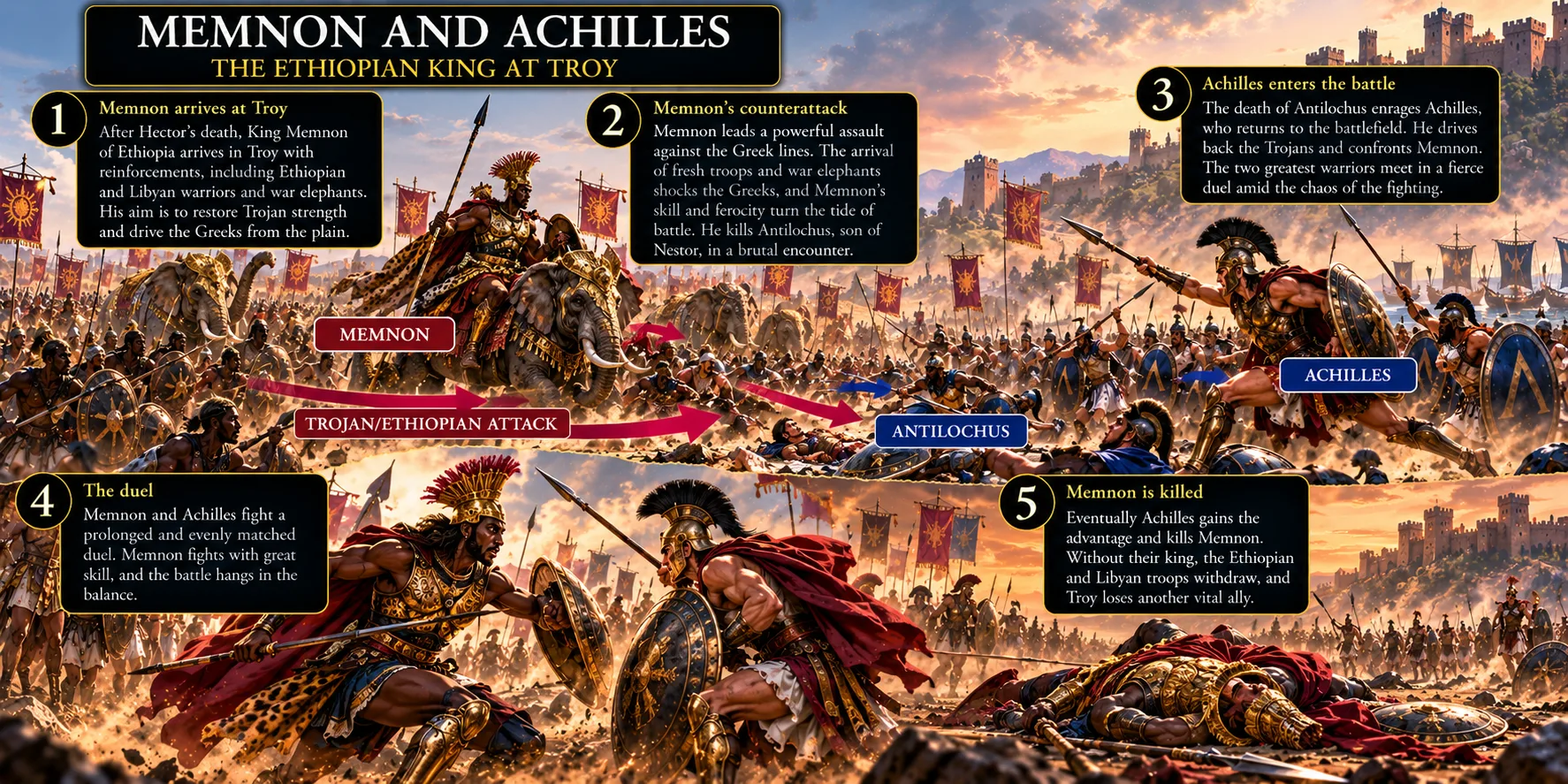
Memnon's Aethiopian forces and their Trojan allies against the Greeks, culminating in Memnon against Achilles.
Forces
Exact numbers are not preserved. Quintus describes Memnon arriving with a substantial Aethiopian army that reinforces the Trojans.
Objective
Memnon's arrival is intended to restore Troy's ability to fight in the field after the deaths of Hector and Penthesilea and to push the Greeks back from the city.
Source-based schematic
Battle Movement
Not to geographic scale
This diagram shows movements or positions described
in the surviving literary tradition. It does not
claim to reconstruct exact ancient battlefield
coordinates.
Illustrated interpretation of Memnon's intervention at Troy,
the death of Antilochus and Memnon's final confrontation with Achilles.
Movements and positions are schematic interpretations of the surviving literary tradition.
Battle Analysis
Strategy
Memnon commits his allied force directly to a major field engagement and personally leads the attack. His success as a front-line champion creates panic among sections of the Greek army.
Tactics
The battle combines massed fighting with champion combat. Memnon kills Antilochus and continues driving Greeks toward the Hellespont. Nestor then appeals to Achilles, drawing the Greek champion toward Memnon.
Turning Point
The death of Antilochus brings Achilles directly against Memnon. What had been a successful allied advance becomes concentrated around a duel between the two strongest champions.
Decisive Move
After a prolonged exchange using spears and swords, Achilles drives his weapon beneath Memnon's breast and kills him.
Why did the result happen?
Memnon's army performs strongly while its commander remains active, but the battle depends heavily on heroic leadership. Once Achilles kills Memnon, the Aethiopian and Trojan momentum collapses.
Outcome
Memnon is killed and his allies retreat. Troy loses another major external champion capable of confronting Achilles.
The detailed surviving narrative is chiefly preserved in Quintus Smyrnaeus, Fall of Troy Book 2. The wider Memnon story belonged to the lost epic tradition as well.
Before Troy; several traditions connect the death with the Scaean Gate
Sides
Achilles fighting against Troy, with Paris and Apollo associated with his death in an important tradition.
Forces
No useful numerical reconstruction is preserved for the particular action in which Achilles dies.
Objective
Achilles continues fighting against Troy after the deaths of Hector, Penthesilea and Memnon.
Source-based schematic
Battle Movement
Not to geographic scale
This diagram shows movements or positions described
in the surviving literary tradition. It does not
claim to reconstruct exact ancient battlefield
coordinates.
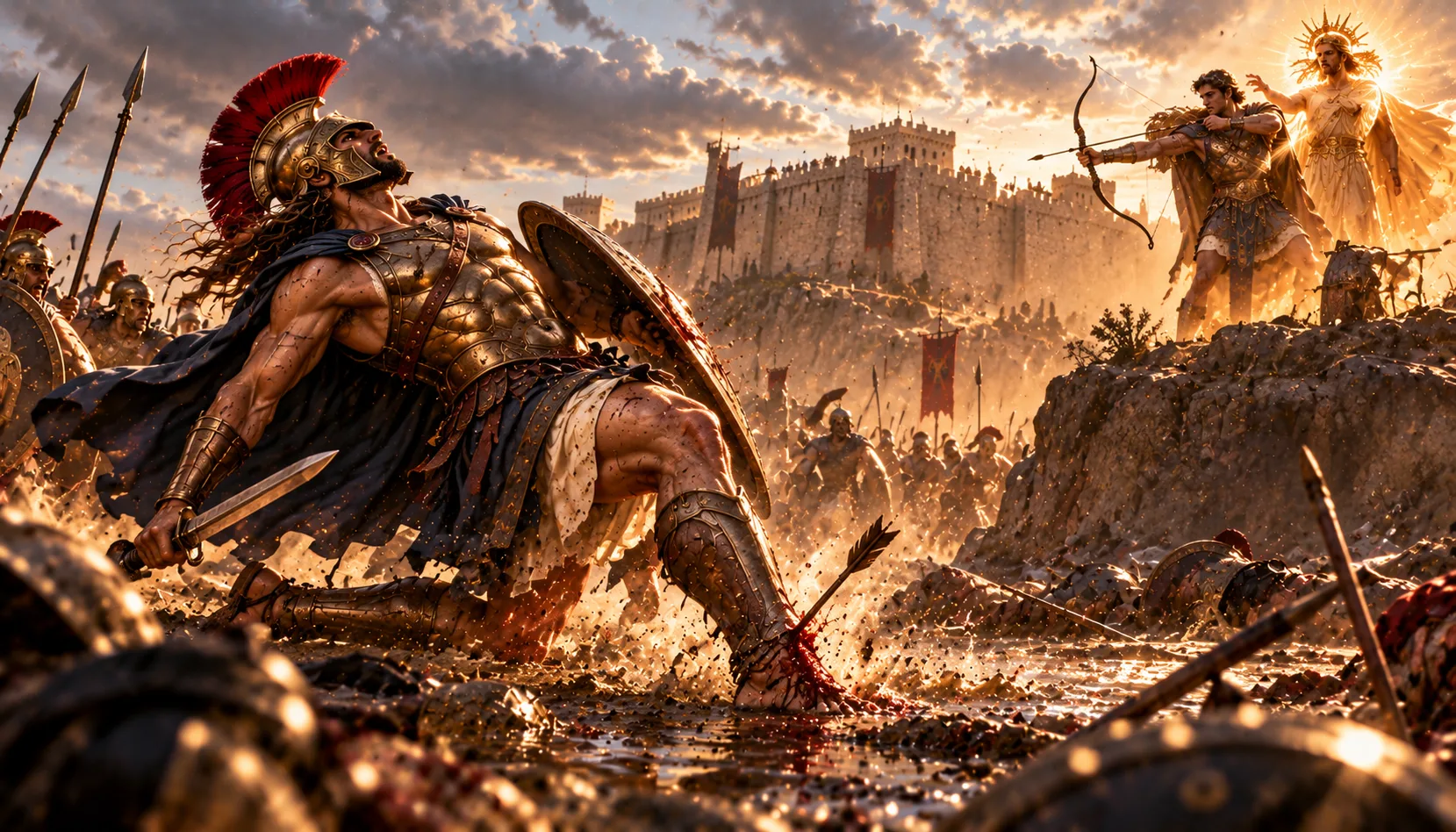
Illustrated interpretation of the death of Achilles before Troy.
Later tradition famously places the fatal wound at his heel and
associates Paris' shot with the intervention of Apollo. The surviving
ancient traditions vary in their details of Achilles' death.
Battle Analysis
Strategy
The surviving tradition does not preserve a detailed battle plan comparable with the Iliad's description of Hector's final duel.
Tactics
The familiar tradition presents Achilles as vulnerable to missile attack despite his superiority in direct combat.
Turning Point
Achilles is struck by the fatal missile associated with Paris and Apollo.
Decisive Move
Paris and Apollo jointly bring down Achilles in the tradition preserved by Apollodorus.
Why did the result happen?
Achilles' death is framed less as defeat through superior battlefield tactics than as the fulfilment of his destined mortality through divine involvement.
Outcome
Achilles dies, causing a major crisis for the Greeks. A fierce struggle follows over possession of his body.
The Greeks discover that Troy cannot fall without Philoctetes and the bow of Heracles, forcing them to return for the warrior they abandoned.
Location
Lemnos and the Greek camp before Troy; this operation crosses locations rather than forming one battlefield.
Sides
Greek envoys seeking Philoctetes and the bow of Heracles; the wider strategic opponent remains Troy.
Forces
A small recovery mission rather than a mass battlefield engagement.
Objective
The Greeks must recover Philoctetes and the bow of Heracles after learning that Troy cannot fall without them.
Source-based schematic
Battle Movement
Not to geographic scale
This diagram shows movements or positions described
in the surviving literary tradition. It does not
claim to reconstruct exact ancient battlefield
coordinates.
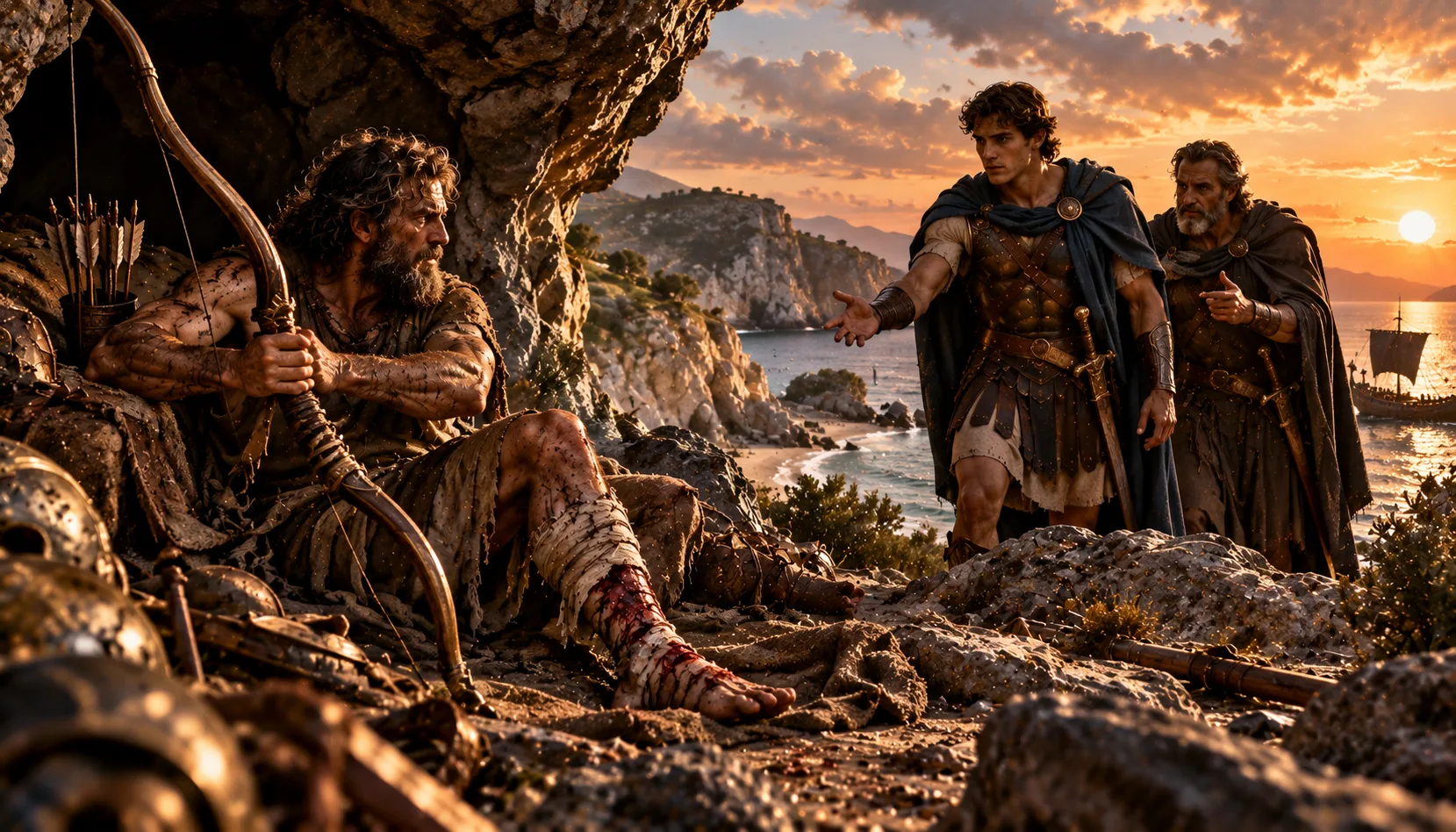
Illustrated interpretation of the recovery of Philoctetes from Lemnos.
The wounded archer possesses the bow of Heracles, which prophecy makes
essential to the fall of Troy. Odysseus and Neoptolemus are sent to
bring both Philoctetes and the bow back to the Greek army.
Battle Analysis
Strategy
Instead of another frontal assault on Troy, the Greeks respond to prophecy by acquiring a missing strategic asset.
Tactics
Odysseus and Neoptolemus become central to the effort to bring back the warrior whom the Greeks previously abandoned.
Turning Point
The campaign against Troy changes once the Greeks accept that military strength alone cannot satisfy the conditions required for victory.
Decisive Move
Philoctetes and the bow of Heracles are restored to the Greek war effort.
Why did the result happen?
The Greeks adapt their strategy to prophecy and recover a specialist warrior and weapon that had been absent from the campaign.
Outcome
Philoctetes returns to the Trojan War, enabling the next sequence of events leading toward the death of Paris and the eventual fall of Troy.
The Philoctetes tradition survives in multiple sources, including Sophocles. It is better classified as a strategic operation than as a conventional battle.
The Greek coalition under its surviving commanders against the Trojans inside the fortified city.
Forces
Ancient traditions disagree dramatically over the number of warriors concealed in the Wooden Horse. No reliable total strength should be reconstructed from those figures.
Objective
After years of unsuccessful siege warfare, the Greeks must bypass Troy's fortifications and open the city from within.
Source-based schematic
Battle Movement
Not to geographic scale
This diagram shows movements or positions described
in the surviving literary tradition. It does not
claim to reconstruct exact ancient battlefield
coordinates.
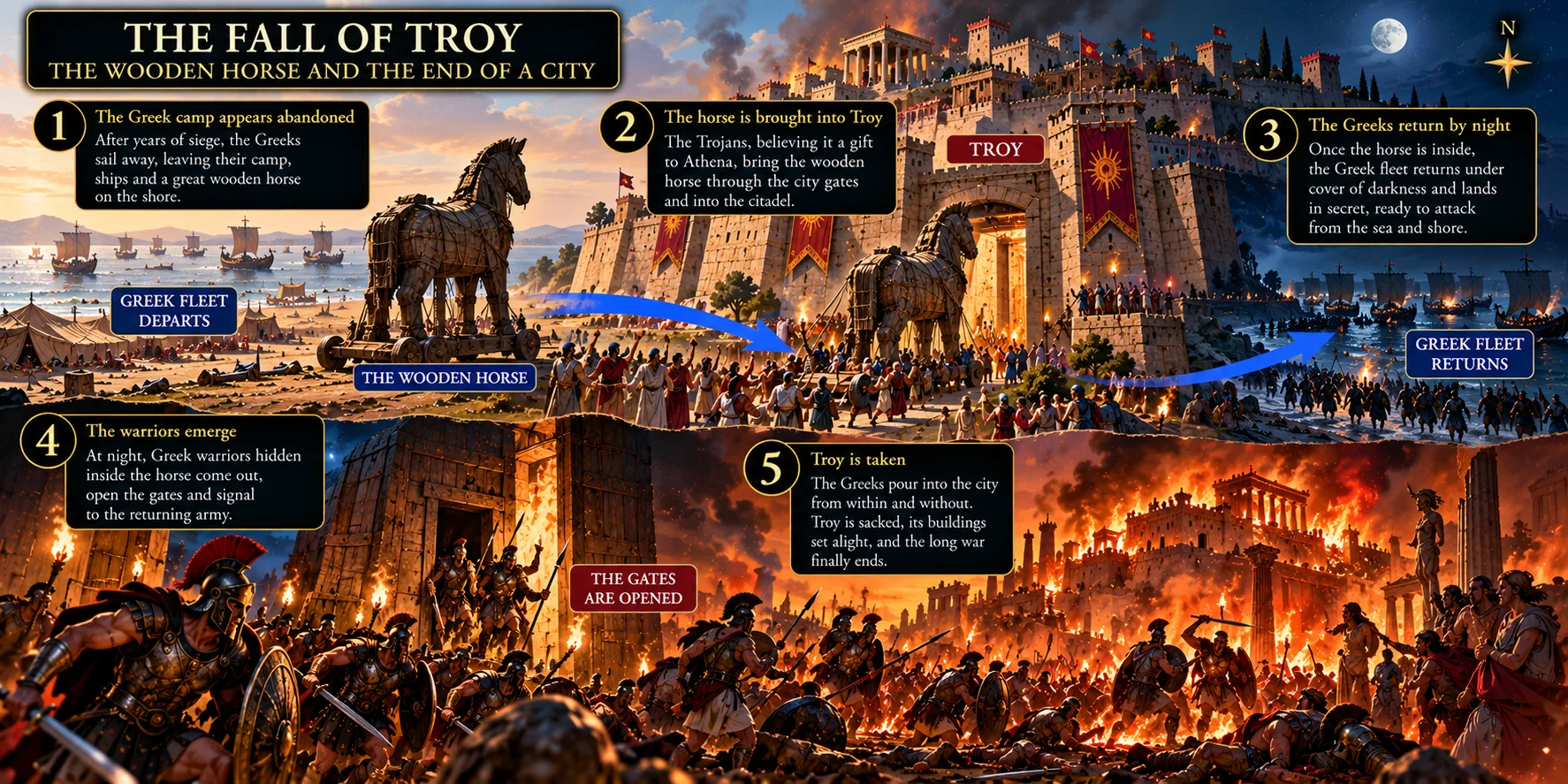
Illustrated interpretation of the wooden horse stratagem and the fall of Troy.
Movements, positions and the appearance of the city are schematic interpretations
of the surviving literary tradition.
Based primarily on the final-operation sequence
preserved in Apollodorus, Epitome 5.
Battle Analysis
Strategy
Odysseus' plan replaces direct assault with deception. Selected warriors hide inside the Wooden Horse while the main Greek force appears to abandon the siege and withdraw toward Tenedos.
Tactics
The Trojans bring the horse inside despite warnings. At night Sinon gives the signal, the fleet returns, the hidden warriors emerge and the city gates are opened.
Turning Point
The decisive error occurs when the Trojans accept the horse into the fortified city rather than destroying it.
Decisive Move
The concealed Greeks emerge after nightfall and open the gates for the returning army.
Why did the result happen?
The Greeks finally neutralise Troy's greatest defensive advantage — its walls — by making the defenders carry the infiltration force through those defences themselves.
Outcome
The Greek army enters Troy during the night and sacks the city, ending the war and destroying Priam's royal house.
Apollodorus, Epitome 5.14–21. Ancient versions vary in details and numbers, but the withdrawal to Tenedos, signal, hidden warriors and opening of the gates form a clear operational sequence.
The Iliad covers only a short period of the
Trojan War. Episodes such as Achilles' encounters with
Penthesilea and Memnon belong to the wider Trojan epic
tradition, while other wars such as Seven Against Thebes
form entirely separate heroic cycles.