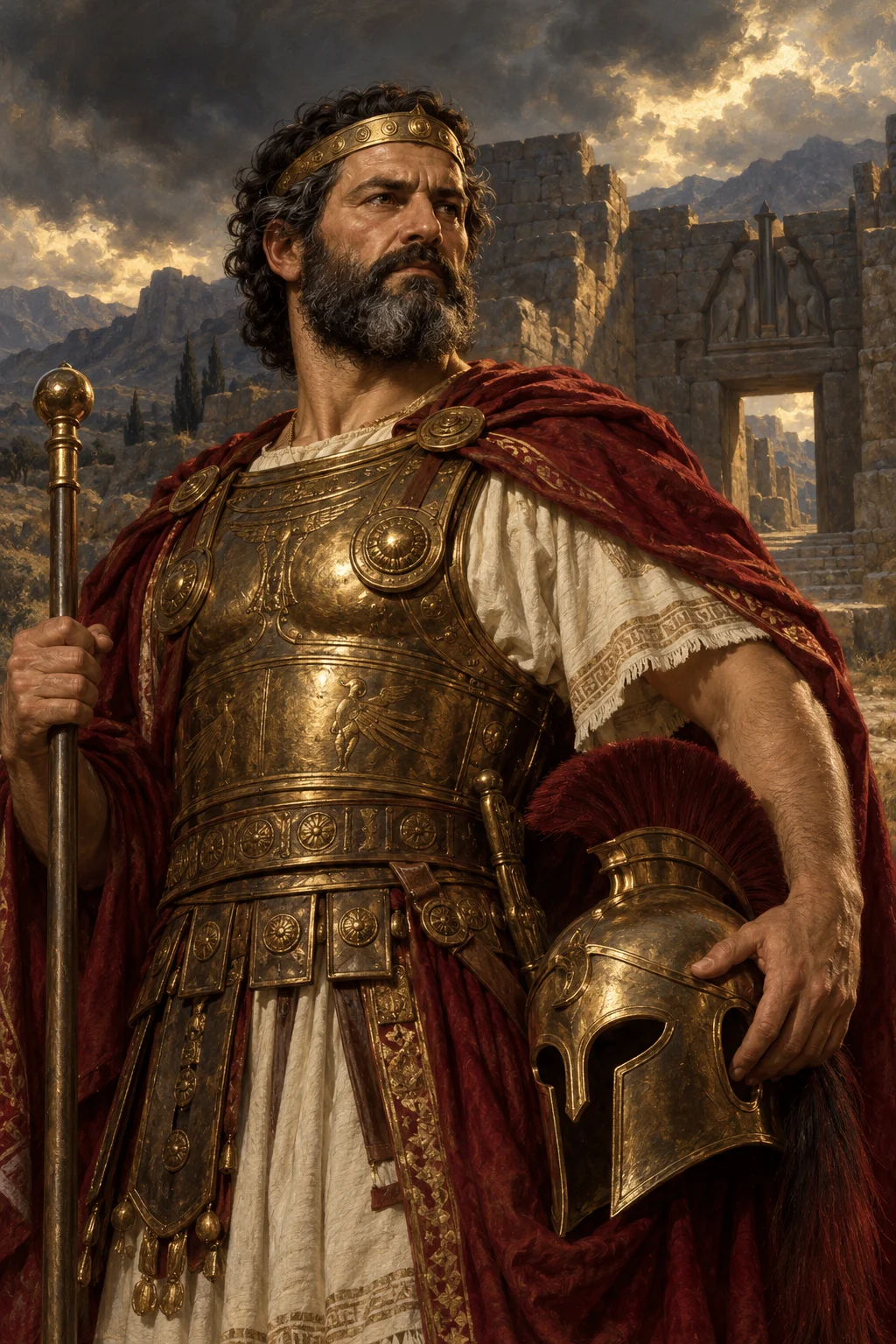
Agamemnon
Overview
Agamemnon is the king of Mycenae and commander of the Greek coalition in the Trojan War. A son of Atreus and brother of Menelaus, he stands at the centre of the House of Atreus, the sacrifice of Iphigenia, the fall of Troy and the cycle of revenge that ends in his murder by Clytemnestra and Aegisthus.
Generation
Trojan War
Symbols
Sceptre, Mycenae
Notes
Agamemnon is one of the central royal figures of the Trojan War tradition. He is usually presented as king of Mycenae, son of Atreus and brother of Menelaus. When Helen is taken to Troy, Agamemnon becomes commander of the Greek coalition assembled to recover her.
His authority is powerful but repeatedly difficult. In the Iliad, Agamemnon's conflict with Achilles becomes one of the central causes of crisis within the Greek army. Their dispute over honour and status leads Achilles to withdraw from the fighting, with disastrous consequences for the Greeks.
Before the fleet can sail for Troy, Agamemnon also becomes involved in the sacrifice of his daughter Iphigenia at Aulis. Ancient traditions differ over why Artemis is angry with him and over whether Iphigenia actually dies, but the episode becomes one of the most important events in the later history of his household.
The sacrifice helps explain Clytemnestra's hatred of Agamemnon. During the ten years of the Trojan War, Clytemnestra forms a relationship with Aegisthus, whose own connection with the House of Atreus reaches back to the feud between Atreus and Thyestes.
Agamemnon eventually returns home after the fall of Troy, bringing Cassandra with him as a captive. Cassandra knows that death awaits them, but her prophetic curse means that her warnings are not believed.
Agamemnon is then murdered by Clytemnestra and Aegisthus. Ancient sources differ over the precise circumstances of the killing and over the relative responsibility of the two conspirators, but his death becomes the immediate cause of Orestes' later revenge.
His story therefore connects several of the largest narrative cycles in Greek mythology. Through Menelaus he belongs to the background of the Trojan War; through Iphigenia and Clytemnestra he connects the war to the destruction of his own household; and through Orestes his murder becomes part of the later conflict between vengeance and justice.
Agamemnon also belongs to the longer curse of the House of Atreus. The violence between Atreus and Thyestes does not end with their generation. Aegisthus, descended from Thyestes, becomes one of the agents of Agamemnon's death, while Orestes continues the cycle by killing Aegisthus and Clytemnestra.
The surviving Greek tradition therefore presents Agamemnon as more than a victorious war leader. He is a king whose military authority, family history and personal decisions place him at the intersection of the Trojan War and one of Greek tragedy's most enduring cycles of inherited violence.
Children
Family Cycle
The House of Atreus
Agamemnon belongs to the dynasty whose story connects Atreus and Thyestes with Agamemnon, Clytemnestra, Orestes and the cycle of inherited revenge.
Explore the complete House of Atreus →Related Myths
-
Tyndareus and the Suitors of Helen
Agamemnon belongs to the wider royal family whose history leads into the Trojan War. -
Atreus and Thyestes
Son of Atreus whose later fate continues the family conflict -
The Feast of Thyestes
Later descendant of the House of Atreus whose fate continues the family's cycle of violence -
The Murder of Atreus
Son of Atreus who survives and later returns to power -
The Sacrifice of Iphigenia
Father and Greek commander -
The Trojan War
Commander of the Greek coalition -
The Fall of Troy
Greek commander at the sack of Troy -
The Murder of Agamemnon
Murdered king -
The Revenge of Orestes
Murdered father whose death Orestes seeks to avenge -
Orestes and the Erinyes
Murdered father whose vengeance creates Orestes' moral conflict -
The Trial of Orestes
Murdered father whose death is central to Orestes' defence