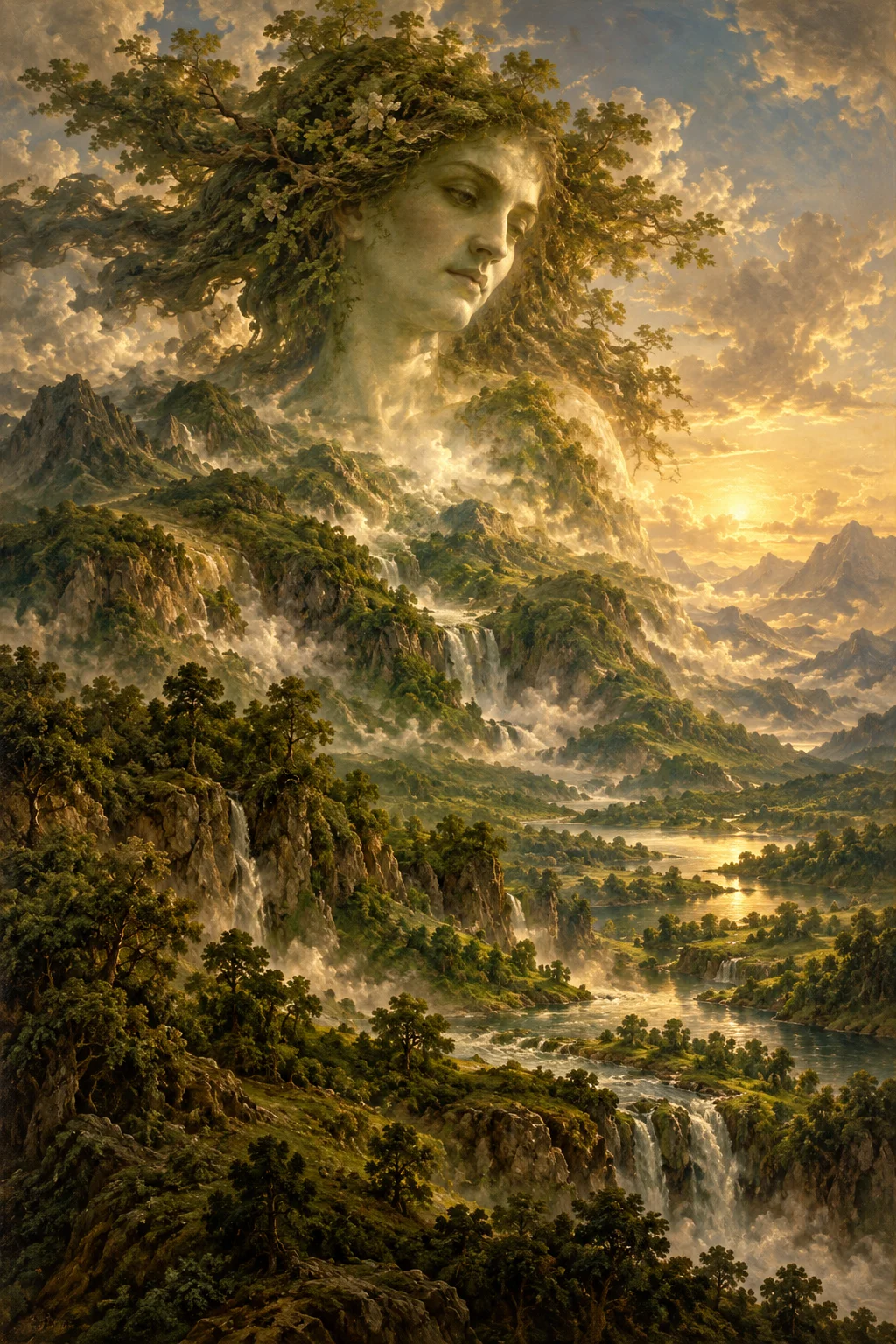
Gaia
Overview
Primordial goddess and personification of the Earth.
Generation
Primordial
Symbols
Earth, fertility
Parents
Unknown or primordial.
Beyond Antiquity
Modern Legacy
Gaia still appears in the modern world through language, science, medicine, astronomy or culture.
Gaia
Today: A name widely used in Earth science, ecology and environmental thought.
Gaia was the primordial Earth in Greek mythology. Her name has been reused in modern scientific contexts concerned with Earth as an interconnected planetary system.
Explore Gaia in modern science →Gaia Hypothesis
Today: A scientific hypothesis describing interactions between living organisms and Earth's environment.
The hypothesis was named Gaia after the Greek personification of Earth, reflecting its view of Earth as a strongly interacting system.
Explore Gaia in modern science →Related Myths
-
Creation from Chaos
Primordial Earth -
Gaia and Uranus
Primordial Earth and mother of the first great divine dynasty -
The Overthrow of Uranus
Plans the overthrow of Uranus -
Cronus and Rhea
Helps Rhea preserve the youngest child -
The Birth and Concealment of Zeus
Helps protect the newborn Zeus -
The Titanomachy
Provides crucial counsel to Zeus -
Typhon's Challenge to Zeus
Mother of Typhon in the Hesiodic tradition -
Pontus and the First Sea Gods
Primordial Earth and mother of the first sea gods with Pontus -
The Gigantomachy
Mother of the Giants